
How to Use AI to Set and Track OKRs in 2026 (The Real Playbook)

How to Use AI to Set and Track OKRs in 2026 (The Real Playbook)
Q1 kicked off with three ambitious OKRs. It's April. You couldn't find last quarter's doc if you tried. The quarterly review is next Tuesday and somebody's going to ask how things went.
Sound familiar? Here's the frustrating part — it wasn't a commitment problem. You cared. Your team cared. Something more basic broke.
Teams using AI-driven goal guidance based on psychometric and behavioral science are 4x more likely to meet their objectives on time. — malife.app, 2026
Four times more likely. Same people, same ambition — different system.
OKRs don't die because you don't try hard enough. They die because the setting is sloppy, the tracking is manual, and the feedback shows up too late to matter.
In 2026, AI fixes all three. Here's how to use it — concretely — at each layer.
The Three Places OKRs Actually Break
Before picking a tool, diagnose the failure.
- Setting — your objectives are vague, your key results aren't measurable, and nobody agrees on what "done" looks like.
- Tracking — updates happen every 3 weeks in a Notion page, which means you're flying blind for 21 days at a time.
- Course correction — by the time you notice you're behind, it's week 10 and the quarter's already cooked.
AI helps in different ways at each layer. If you don't match the layer, you'll buy the wrong tool.
Layer 1: AI for Setting Better OKRs
AI Turns Ideas Into SMART Drafts — Fast
The hardest part of OKRs is starting. You have an ambition ("make the product stickier"). You don't have an OKR.
Using AI for goal setting helps managers create SMART goals faster, align team objectives with company OKRs, and track progress in real time. — Emily Helen Arnold, People Strategy Specialist at Teamflect
A good AI turns your fuzzy idea into a structured draft in 30 seconds:
Objective: Make the product so sticky users engage weekly without prompting. KR1: Increase 4-week retention from 38% to 52%. KR2: Reduce activation time from 14 days to 7. KR3: Drive WAU/DAU ratio from 0.32 to 0.45.
You'll edit it. You might throw out two of the three KRs. Doesn't matter. The blank page is gone.
AI Picks Metrics That Actually Matter
The second trap in OKR setting: picking measurable things that don't matter. Vanity metrics in key-result clothing.
This is where AI becomes weirdly useful:
Predictive analytics can reveal emerging customer needs, helping product teams set OKRs tied directly to value delivery. — AgileSeekers
Feed your AI your historical data, market context, and customer behavior. Ask: "Which of these candidate KRs most correlate with the outcome we actually want?"
You'll get pushback on your favorite vanity metric. Listen.
AI Tailors KRs by Role
The best AI OKR tools know that sales and support shouldn't be measured the same way.
AI also tailors metrics to specific roles. This ensures each department has actionable, measurable targets. — malife.app
Sales gets pipeline metrics. Support gets response-time and CSAT. Engineering gets velocity and uptime. You don't force-fit everyone into one frame.
Layer 2: AI for Tracking OKRs (Without Manual Updates)
Here's where most teams quietly fail. Tracking an OKR manually means someone — usually you — logs into a spreadsheet every Friday to pretend the numbers have changed.
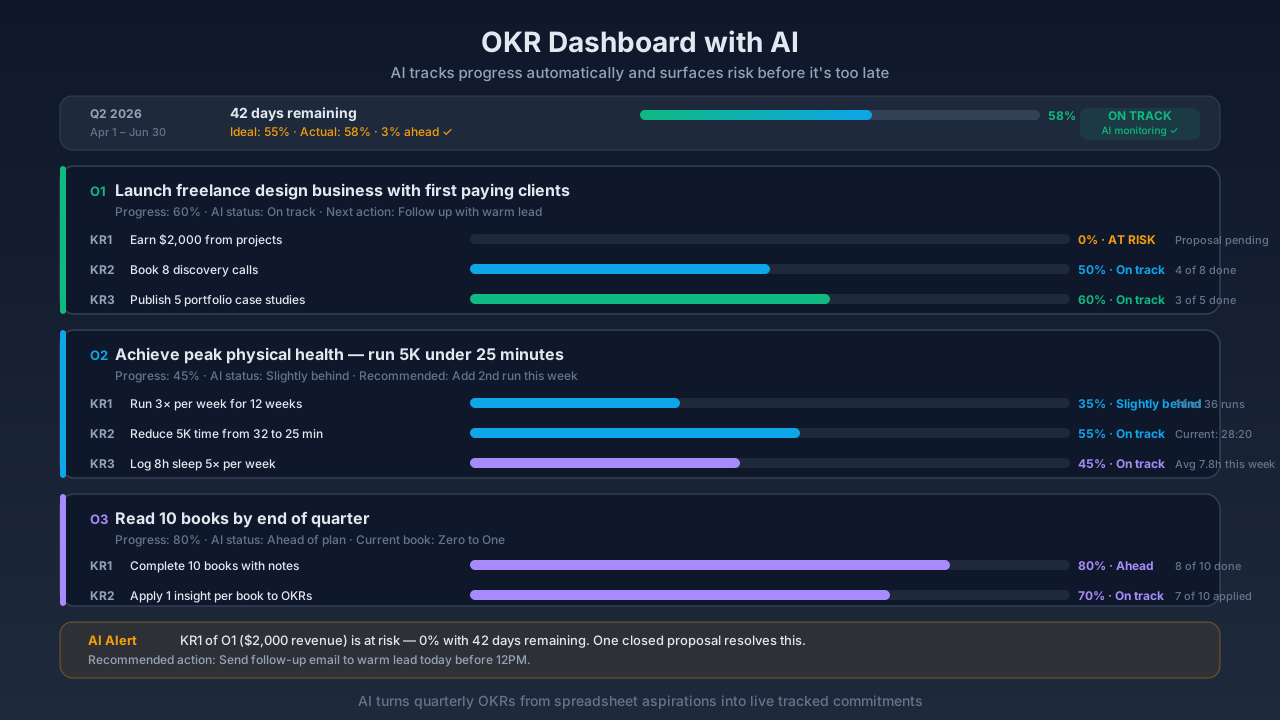
AI kills that ritual.
Progress updates automatically as linked tasks are finished, eliminating the need for manual tracking. — ClickUp, 2026
Modern AI OKR systems pull data directly from:
- CRMs (for sales pipeline)
- Project management tools (for delivery velocity)
- Analytics dashboards (for product metrics)
- Slack / Teams (for engagement signals)
- Calendars (for time allocation)
No one updates a field. The KR ticks on its own.
This is a mundane-sounding change that is actually huge. When tracking is frictionless, you see reality. When it's manual, you see what people were willing to type on a Friday afternoon.
Layer 3: AI for Course Correction (The Killer Feature)
Here's the capability that changes the whole game.
Advanced systems are capable of analyzing hundreds of variables to identify risks that might otherwise go unnoticed. — malife.app
Case study cited in the same source: one global tech company applied AI to monitor 347 factors to assess and predict the success of their quarterly OKRs.
347 variables. Weekly. Flagging risks before humans would ever notice.
A common alert threshold: <20% completion halfway through the quarter triggers intervention. That's weeks before your Slack channel would start panicking organically.
Alongside risk detection, the best 2026 tools recommend next actions:
The AI identifies high-leverage actions based on what's working, what's stalled, and where your efforts can have the most impact. — OKRs Tool
Translation: not just "you're behind on KR2", but "start here, stop this, try this." Prescriptive, not just diagnostic.
The Case Study: Fortune 500 Alignment Win
Setting OKRs at scale across teams is a classic mess. Different teams chase different shiny things, their KRs contradict each other, nobody notices for months.
A Fortune 500 financial services company adopted AI-powered OKR analytics in 2024. Within six months, the system flagged resource allocation conflicts. — malife.app
AI mapped millions of relationships between outcomes, teams, and actions, surfacing the kind of hidden conflicts that humans miss for quarters at a time.
You don't need to be Fortune 500 for this to matter. Even a 6-person startup has team-level OKR overlaps and gaps. AI surfaces them faster than any weekly sync can.
Engagement Insights Without Survey Fatigue
One of the subtler 2026 capabilities:
AI-Led Engagement Insights continuously monitors platform interactions, activity levels, and engagement patterns in real time — without needing disruptive check-ins or pulse surveys. — OKRs Tool
Instead of pinging the team with "rate your motivation 1–10 😊", AI reads the actual signal: who's active in goal-related tools, who's checking in, who's gone quiet.
Quiet engagement detection is especially powerful for remote and async teams. You find out Priya hasn't touched her KR dashboard in 12 days before the quarterly review.
The Smart OKR Assistant Loop
Good AI doesn't just track. It adapts.
If your team completes a key result early, the Assistant recommends a more ambitious follow-up OKR tailored to your current momentum. — OKRs Tool
Early wins? Ambition ratchets up instead of coasting.
At the end of each cycle, the system automatically evaluates the quality and effectiveness of your goals, analyzes progress patterns, and provides data-driven recommendations for the next cycle. — OKRs Tool
Cycle-end retros become data-rich instead of vibes-based. What OKRs routinely get overweighted? Which teams consistently overshoot? Which objectives keep getting re-hashed? The feedback loop compounds.
Personal OKRs: AI Isn't Just for Companies
Everything above applies at a personal level too. And arguably works better there — because you have a lot less political resistance to AI surfacing uncomfortable truths about yourself.
A personal OKR in 2026 can be:
- Drafted with AI from a life ambition ("get in the best shape of my 30s")
- Broken into weighted key results ("body fat < 15%", "5 workouts/week", "resting HR < 60")
- Tracked automatically via Strava, Whoop, Apple Health, or an OKR-native tool
- Flagged in real time if you drift (missed 3 workouts in a row → intervention)
- Adjusted quarterly based on what actually moved
That's a personal operating system. Most people run "hope" instead.
The Risk: AI Without Judgment Is Worse Than No AI
Don't get tool-drunk. Here are the classic failure modes:
- Over-optimization on what AI can measure. AI loves numbers. Some of your real KRs are qualitative ("stronger relationships with top 10 customers"). Don't let the tool pretend those don't count.
- Delegating judgment. AI flags risk. You decide whether it matters. Never accept an AI recommendation as a decision — only as input.
- Ambition inflation. When AI auto-raises goals after early wins, sometimes the right answer is "yes, go harder." Sometimes it's "no, that's a burnout trap." You judge.
- Privacy. If you feed personal life data to a corporate OKR tool, know where it goes. Read the policies.
AI is the second brain. You're still CEO.
The 2026 AI OKR Tooling Landscape (Quick Orientation)
- Purpose-built AI OKR tools — OKRs Tool, Malife, Perdoo — full setting + tracking + feedback loops.
- General goal platforms with AI layer — ClickUp Brain, Tability — great if your work already lives there.
- Personal-first AI OKR systems — tools built around individuals, not teams. IdealWeek is one — it ties AI-assisted OKR creation to weighted key results, action checklists, and a behind-the-plan alert system that flags when you drift.
- General LLMs — ChatGPT, Claude — brilliant at the setting layer, weak at automatic tracking. Pair with something else.
The stack pattern wins again: LLM for setting and thinking, purpose-built tool for tracking and alerts.
Do This Right Now (15-Minute OKR Reset)
This works for personal OKRs. Adapt it for team ones.
- Open your AI of choice.
- In 3 sentences, write the ambition that matters most this quarter.
- Prompt: "Turn this ambition into one Objective and 3 SMART Key Results with numeric targets. Tell me which KR is most likely to be a vanity metric."
- Edit the output. Keep the KR the AI flagged as vanity only if you can defend it.
- For each KR, write: the data source, the weekly tracking point, and a single action you'll take in the next 7 days.
- Put a 20-minute weekly OKR review on your calendar — same day, same time, every week.
- Put a 60-minute end-of-quarter review on your calendar right now, for July.
You now have an AI-drafted, measurable, trackable OKR. With a review cadence. Backed by research that gives you a 4x edge on hitting it.
That's what 15 minutes well spent looks like in 2026.
A year from now, you'll either have four quarters of compounded progress — or four abandoned quarterly docs. The 4x edge is real. You just have to actually point the tool at something.
Pick the ambition. Prompt the AI. Schedule the review.
Now.
Related Articles
View all →
Best AI Goal Setting Apps in 2026: The Honest, Data-Backed Ranking
"Launch a side business by year-end."

The OKR Framework Explained: How John Doerr's Goal-Setting System Actually Works
**You've set goals before. Probably dozens of them.** New Year's resolutions. Quarterly targets. That fitness plan you wrote out on a Sunday…

Notion Life OS vs Dedicated Goal Apps: Which Is Better for Execution in 2026
You saw the template on TikTok. You paid $49. You spent a Saturday building the Notion Life OS of your dreams — OKR database, habit tracker,…