What Are OKRs and How Do They Work: A Complete Guide

What Are OKRs and How Do They Work: A Complete Guide
You've heard the term. Maybe you've seen it in a job description or watched a TED Talk. But when it comes to actually using OKRs yourself, there's a gap between knowing they exist and knowing how to make them work.
Most people don't fail because they lack ambition. They fail because they have no bridge between their dreams and their daily actions. OKRs are that bridge.

The OKR Framework Explained
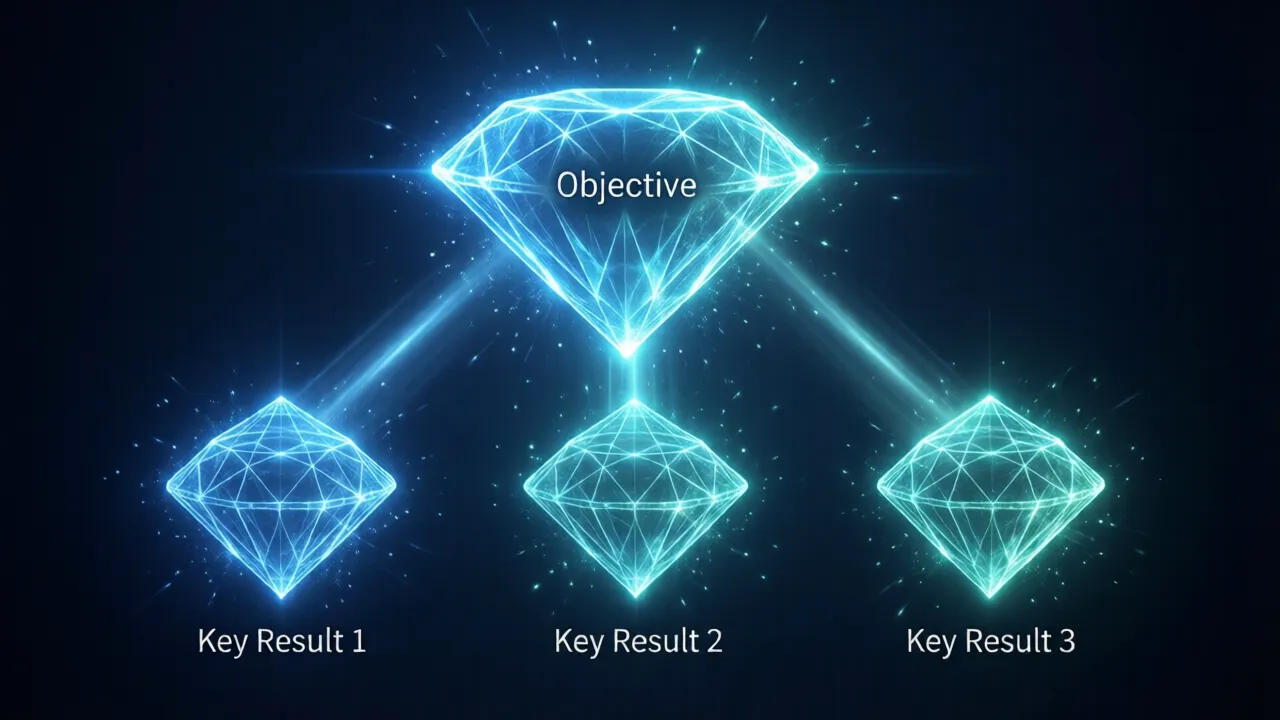
OKR stands for Objectives and Key Results. It's a goal-setting framework used by individuals, teams, and organizations to define measurable goals and track their outcomes. The system is deceptively simple:
- The Objective is what you want to achieve — qualitative, significant, and inspirational
- The Key Results are how you'll measure progress — 3-5 specific, numerical outcomes
That's it. But here's what makes OKRs different from every other goal-setting method you've tried: there's no grey area. At the end of the cycle, you can look at each key result and answer one question: Did I do that or did I not do it?
No interpretation. No self-deception. No "I kind of made progress."
Where OKRs Came From (And Why They Spread)
The OKR framework wasn't invented in a boardroom. It was forged in the competitive pressure of the semiconductor industry.
In the 1970s, Andy Grove — CEO of Intel — developed the approach and documented it in his 1983 book High Output Management. Grove called it "iMBOs" (Intel Management by Objectives), but the core idea was revolutionary: pair every objective with measurable key results.
In 1975, a young Intel salesperson named John Doerr attended Grove's course and learned the methodology. Twenty-four years later, Doerr — now at venture capital firm Kleiner Perkins — introduced OKRs to a small startup called Google.
The rest is history.
OKRs quickly became central to Google's culture. Larry Page, co-founder and former CEO of Alphabet, credited OKRs in the foreword to Doerr's 2018 book Measure What Matters:
"OKRs have helped lead us to 10× growth, many times over. They've helped make our crazily bold mission of 'organizing the world's information' perhaps even achievable. They've kept me and the rest of the company on time and on track when it mattered the most."
Since then, OKRs have spread through the tech world and beyond: LinkedIn, Twitter, Uber, Microsoft, GitLab — the list goes on. But here's the thing most articles won't tell you: OKRs aren't just for companies. They're for anyone who refuses to sleepwalk through their goals.
How to Write OKRs That Actually Work
Start With the Objective
An objective is not a task list. It's not "launch website" or "hire three people." Those are projects. An objective is what improvement looks like when you're done.
A strong objective is:
- Significant — it matters to your bigger vision
- Concrete — you can describe what success looks like
- Clearly defined — no ambiguity about what you're aiming for
- Inspirational — it pulls you forward, not pushes you from behind
Avoid words like "help," "consult," or "support." These describe activities, not outcomes. Instead of "Help improve customer satisfaction," try "Transform the customer onboarding experience."
Define 3-5 Key Results
Under each objective, you need 3-5 key results. Not 10. Not 2. Three to five.
Key results must be measurable — either on a 0-100% scale or with a numerical value (count, dollar amount, percentage). There should be no room for debate. At the end of the cycle, you either hit the number or you didn't.
Examples of strong key results:
- Increase email marketing qualified leads from 100 to 150
- Improve conversion rate from trial to paid from 20% to 35%
- Complete onboarding steps for 500 new users
- Achieve 8/10 average score on customer satisfaction survey with 100+ responses
Notice what these are not: activities. "Send 100 emails" is an activity. "Increase qualified leads from 100 to 150" is an outcome. The activity is what you do to move the key result. The key result is the business value you create.

The 70% Rule
Here's where most people get OKRs wrong: they set targets they know they can hit. That's not the point.
John Doerr recommends a 70% target success rate for aspirational key results. If you're consistently hitting 100%, your goals are too easy. The 70% threshold encourages stretch goals — ambitious enough to pull real effort out of you, but not so impossible that you give up before starting.
There are two types of key results:
- Aspirational — aim for 70%; these are moonshots that push your limits
- Committed — expect 100%; these are non-negotiable deliverables
Most of your OKRs should be aspirational. If you're not failing sometimes, you're not aiming high enough.
The Quarterly OKR Cycle
OKRs operate on a 3-month cycle. Not annual. Not monthly. Quarterly.
Here's why: three months is enough time to deliver meaningful outcomes, but short enough to course-correct if you're wrong. On an annual cycle, you can spend 11 months going in the wrong direction before realizing it. With quarterly OKRs, you get four shots per year to adjust.
The OKR Process
Week 1: Plan, Set, and Align At the start of each quarter, you define your OKRs. Review your long-term vision. Ask: What's the single most important improvement I can make in the next 90 days? Then define 3-5 key results that prove you've made that improvement.
Weeks 2-12: Track Progress Weekly This is where most goal-setting systems fail — they're set and forgotten. OKRs demand weekly check-ins. Every week, measure your key results. Are you on track? What's blocking you? What initiatives will move the needle this week?
Month 2 and End of Quarter: Review and Learn At the midpoint and end of each quarter, hold a review. What worked? What didn't? What did you learn? The core value of OKRs isn't just achieving goals — it's learning what kind of goals work for you.

Leading vs Lagging Indicators
When choosing key results, measure leading indicators — metrics that give you early warning when something's off.
A lagging indicator tells you what already happened: revenue last quarter, weight lost last month, articles published last week. By the time you see the number, it's too late to change it.
A leading indicator tells you what's about to happen: pipeline growth, daily calorie intake, drafts in progress. These metrics let you course-correct before the quarter ends.
Example: If your key result is "Close $50K in new deals," a leading indicator might be "Number of qualified demos booked." If demos are low in week 3, you know deals will be low in week 12 — and you can act now.
Common OKR Mistakes (And How to Avoid Them)
Mistake 1: Turning OKRs Into a Task List
"I will write 10 blog posts" is not a key result. "Generate 500 qualified leads from content" is. Tasks are inputs. Key results are outcomes.
Mistake 2: Setting Too Many Objectives
You should have 1-3 objectives per quarter. Not 10. Not 5. One to three. If everything is a priority, nothing is.
Mistake 3: Using Vague Language
Words like "improve," "enhance," or "optimize" are weasel words. Improve from what to what? Enhance by how much? Replace vagueness with numbers.
Mistake 4: Tying OKRs to Performance Reviews
When OKRs determine your bonus or promotion, people sandbag — they set easy goals they know they can hit. OKRs are for growth, not evaluation. Keep them separate.
Mistake 5: Ignoring the "Why"
An objective without a purpose is just a number. Every objective should connect to something bigger — your vision, your values, your reason for doing this work. If you can't answer "Why does this matter?" you're not ready to set the OKR.
Why OKRs Work (When Other Methods Fail)
You've tried goal-setting before. New Year's resolutions. SMART goals. Vision boards. Most of them didn't stick. Here's why OKRs are different:
They force clarity. You can't hide behind vague aspirations. Either you hit the number or you didn't.
They create focus. With only 1-3 objectives per quarter, you have to choose what matters. Trade-offs are built into the system.
They enable course-correction. Weekly check-ins mean you catch problems early, not at year-end.
They separate intention from commitment. Saying you want something is easy. Defining how you'll measure it is commitment.
They build accountability. When your key results are visible — to yourself or your team — you show up differently.

How IdealWeek Covers This
IdealWeek was built for people who understand the theory of OKRs but struggle with the execution. Knowing you should set measurable goals is one thing. Actually doing it, week after week, is another.
The OKR Engine is where you define your objectives and key results. Unlike blank-canvas tools that leave you staring at an empty screen, IdealWeek provides AI-assisted OKR creation — type a plain-language goal like "Start a toy shop" and get a full objective with measurable key results, timelines, and suggested actions in seconds. Plus, hundreds of pre-built templates across categories like Business, Family, Health, and Learning give you a starting point when you're stuck.
Each key result in IdealWeek carries a weight — a percentage that reflects its importance. Progress is calculated proportionally, not just by count. And every key result can have its own action checklist, breaking big outcomes into granular steps you can track daily.
The Execution Planner is where vision meets calendar. Most OKR tools stop at goal-setting. IdealWeek goes further: break down your key results into scheduled activities with exact start and end times, log real work hours per OKR, and use the burning candle focus mode to eliminate distractions while you work.
The Insights dashboard shows you what's actually happening. Total progress ring. OKR progress trend chart. Time allocation breakdown over 7 days. And the feature that changes everything: behind-the-plan alerts that compare your actual progress percentage against the ideal percentage based on time elapsed. No more surprises at quarter-end. You'll know on week 3 if you're off track — and exactly how far behind you are.
Long-Term Vision connects your quarterly OKRs to your 10-year vision. Map out 5-year goals, then work backward to quarterly execution. This is the bridge most productivity tools miss: the connection between who you want to become and what you'll do this week.
Unlike general-purpose tools (Notion, Todoist, TickTick) that give you a blank canvas and let you figure out your own system, IdealWeek provides an opinionated framework — a specific method for going from dream to weekly execution, grounded in Jim Rohn's goal-setting philosophy and John Doerr's OKR framework.
IdealWeek is for people who are ready to commit to a method, not just organize their chaos.
Key Takeaways
OKRs (Objectives and Key Results) pair inspirational goals with 3-5 measurable outcomes — no grey area, no self-deception
The 70% rule: if you're consistently hitting 100% of your key results, they're too easy — aim for stretch goals
Quarterly cycles beat annual goals: you get four shots per year to learn and adjust instead of one
Measure leading indicators (what's about to happen) not lagging indicators (what already happened)
OKRs fail when they become task lists, use vague language, or get tied to performance reviews
The difference between intention and commitment is measurement — define how you'll track or it's just a wish
Further Reading
Related Articles
View all →
Best AI Goal Setting Apps in 2026: The Honest, Data-Backed Ranking
"Launch a side business by year-end."

How to Use AI to Set and Track OKRs in 2026 (The Real Playbook)
Q1 kicked off with three ambitious OKRs. It's April. You couldn't find last quarter's doc if you tried. The quarterly review is next Tuesday…

The OKR Framework Explained: How John Doerr's Goal-Setting System Actually Works
**You've set goals before. Probably dozens of them.** New Year's resolutions. Quarterly targets. That fitness plan you wrote out on a Sunday…