
Micro-Habits: Why Tiny Actions Beat Big Routines (The Neuroscience Explains It)

Micro-Habits: Why Tiny Actions Beat Big Routines (The Neuroscience Explains It)
January 2nd. You commit to meditating 60 minutes a day. New you. New life. You feel amazing.
Monday — 60 minutes, eyes closed, legs crossed, champion. Wednesday — 20 minutes, restless, phone glances. Sunday — "I'll start fresh next week." February — you haven't meditated since.
Sound familiar? You're not lazy. You're not weak. You just ran headfirst into the same wall every ambitious person hits. The size of your goal broke your biology.
Here's what the neuroscience actually shows — and why tiny actions, repeated, will change you more than any "big routine" ever will.
The Number That Should Change How You Think
Let's start with the math.
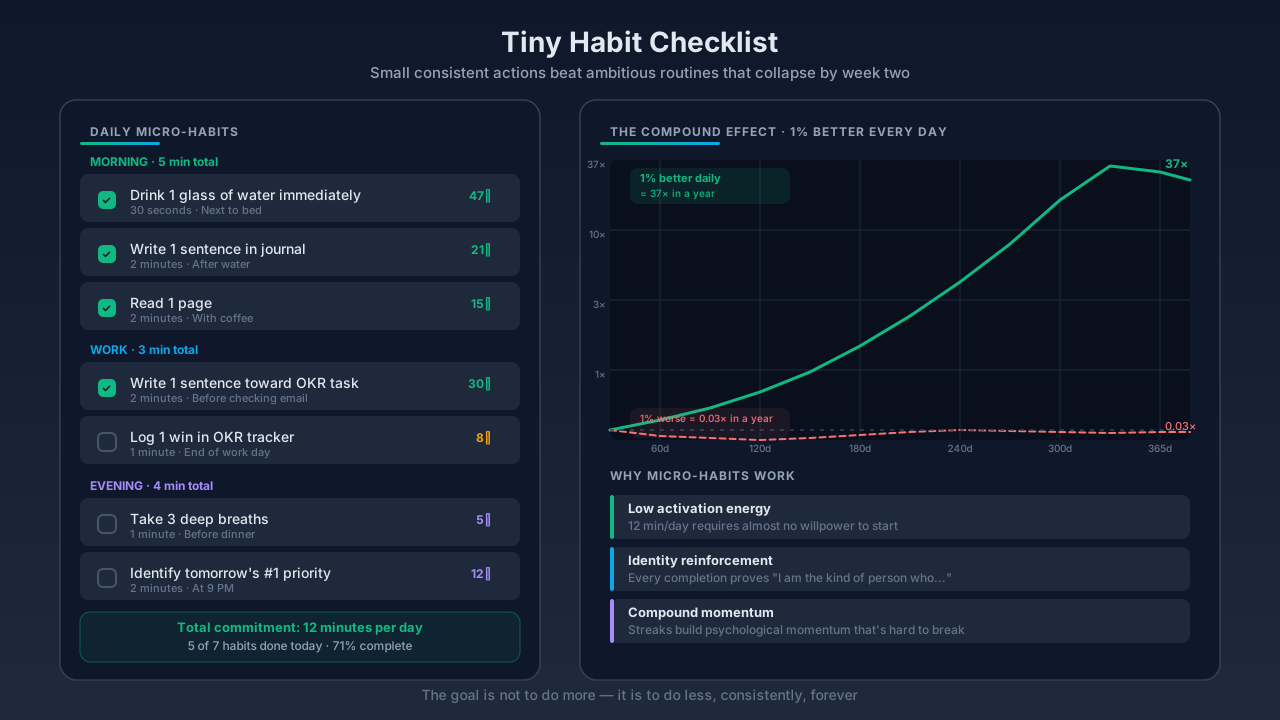
If you can get 1 percent better each day for one year, you'll end up thirty-seven times better by the time you're done. — James Clear, Atomic Habits
Thirty-seven times. Not 37% better. Thirty-seven times.
And conversely, getting 1% worse daily for a year compounds you down to near zero.
That's the entire argument for micro-habits. The small stuff — the 10-minute walk, the two-minute stretch, the one page of reading — is not minor. Over time, it's everything.
Why Big Routines Break Your Brain
Motivation feels like the answer. Motivation is, in fact, the problem.
Motivation is a chemical spark, not a sustainable engine. — Alberto El Bitar, Brainz Magazine
Motivation = dopamine spike. Dopamine spikes = short-lived. When your big ambitious goal doesn't pay off immediately, your brain registers what neuroscientists call reward prediction error — a gap between expected reward and actual reward. Result? Motivation collapses. Fast.
HBR's Sabina Nawaz puts this sharply for goal-setters:
Big goals — like "meditate for an hour every day" — are more burdensome than they are sustainable.
Read: your 60-minute meditation wasn't killed by character flaws. It was killed by biology.
The Actual Mechanism: Neurons That Fire Together Wire Together
Donald Hebb's classic principle from neuroscience:
Neurons that fire together wire together.
Every time you repeat an action, you strengthen a neural pathway. Every time you skip it, that pathway fades. The prefrontal cortex (your effortful, decision-making CEO brain) hands the behavior over to the basal ganglia (your autopilot habit brain) through repetition.
Once that handoff happens, the behavior is no longer a choice. It's a default.
The giant ambitious routine dies before this handoff can occur. The tiny habit survives long enough to make the handoff — because it's small enough that even on your worst day, you do it.
Emotion Creates Habits. Repetition Alone Does Not.
This is the part most habit advice gets wrong.
BJ Fogg, Stanford's behavior scientist, spent decades finding this:
It's not a function of repetition. It's a function of emotion. — BJ Fogg
A habit isn't built by doing the thing 66 times. It's built by feeling successful while doing the thing. That positive emotion is what tells your brain: make this automatic.
Fogg even describes a "one-and-done" phenomenon — a single experience with strong enough positive emotion can wire a habit instantly. You don't have to grind 30 days if the emotion is right.
That's why big goals fail. The 60-minute meditation leaves you feeling behind, inadequate, or bored — negative emotion wires in avoidance, not the habit.
The 2-minute micro version? Easy win. Little hit of pride. "Oh, I did the thing." That emotional signature is what gets coded.
The Two-Minute Rule
So the pragmatic move in 2026 is embarrassingly simple.
Make the habit so small it feels silly to resist.
- Read one page. Not a chapter.
- Stretch for two minutes. Not a 45-minute yoga flow.
- Meditate for 60 seconds. Not an hour.
- Write one sentence. Not 1000 words.
- Do two pushups. Not a full workout.
The point isn't the output. The point is showing up, feeling success, and giving your neural pathway another firing.
Cognitive friction is so low your brain won't fight you. And on days where you want to go bigger? You can — but you've already locked in the win.
Identity Beats Outcome Every Time
The deepest shift isn't behavioral. It's identity.
Every action you take is a vote for the type of person you wish to become. — James Clear
Research backs this. University of Illinois studies on habit persistence found people who link habits to who they are show significantly greater consistency than people chasing outcomes.
There's a massive difference between:
- "I want to lose 10kg." → identity = a person who needs to lose weight
- "I'm someone who moves daily." → identity = a person who moves
The first one is fragile. If the scale doesn't drop fast, the identity collapses. The second is durable. A runner runs. Even after a bad day. Even without motivation. Because the alternative would be violating their own self-concept.
Micro-habits are the cheapest possible vote you can cast for a new identity. Every tiny action tells your brain: this is who we are now.
Fogg's Behavior Model: B = MAP
The underlying science, simplified:
Behavior = Motivation × Ability × Prompt
All three must converge, or the behavior doesn't happen.
- High motivation + low ability = frustration
- High ability + no prompt = forgotten
- High prompt + low motivation + low ability = nothing
Big routines require high motivation AND high ability — and both collapse easily.
Micro-habits maximize ability (make it stupidly easy). That means even when motivation is low, behavior still happens. Which is the entire point — behavior that survives bad days.
Habit Stacking: The Cheat Code
The single best implementation trick: attach the new micro-habit to an existing habit.
- After I pour my morning coffee → I write one sentence in my journal.
- After I brush my teeth → I do 60 seconds of stretching.
- After I sit down at my desk → I write my one priority for the day.
Your brain already recognizes the existing routine. You're riding on an established neural pathway. The new behavior hitchhikes on a highway that already exists, instead of cutting through jungle.
The Growth Protocol: Scale by 10%, Not 10x
Here's where people screw this up. They do the 2-minute version for a week, feel unstoppable, and jump to "now I'll do 30 minutes!"
And the whole thing collapses again.
HBR's research-backed protocol:
Increase the microhabit by only 10% after several weeks of Y's on a "yes list."
Translation: after 3–4 weeks of consistency at 2 minutes, move to 2 minutes 12 seconds. Not 20 minutes. Trust the process. Small stays small until it's automatic. Only then does it grow.
Boring? Yes. That's why it works. Your brain can't sabotage something boring.
Wise Interventions: Environment > Willpower
Gregory Walton's research at Stanford adds one more layer:
Our sense of self, our confidence, and even our relationships are shaped by the environments we move through and the way others see us. — Gregory Walton
Small changes in environment change behavior more reliably than changes in discipline. Sleep clothes in running gear the night before? You run 30% more reliably. Phone in another room at bedtime? Sleep quality goes up. Put the book on your pillow? You read.
Don't fight your willpower. Redesign the 5 feet around your habit.
The Restoration Benefit Nobody Mentions
One more thing the research shows that isn't said enough. Small habits don't just change behavior. They restore you.
A consistent 5-minute morning walk does more for your mental state over a year than a single grueling weekend retreat. A 60-second breathing practice, done daily, lowers baseline cortisol more than a sporadic hour of intense meditation.
The compounding goes both ways — habit compounds capability, but micro-habits also compound wellbeing. Restoration is a stealth benefit nobody sells.
The 2026 Micro-Habit Protocol
Here's the whole thing, condensed.
- Pick the identity you want. Not the outcome. Who are you becoming?
- Choose one micro-habit that casts a vote for it. Ridiculously small.
- Stack it on an existing habit. Name the trigger.
- Celebrate the tiny win every single time. Smile. Say "I'm that kind of person now." Make it emotional.
- Track with a Yes list. Just mark Y when you did it.
- Wait 3–4 weeks. Don't increase. Don't add another habit.
- Scale by 10%. Never 10x.
- Redesign the environment around the habit. Make it easier. Remove friction.
- After 12 weeks, pick habit #2. One at a time.
Boring. Slow. Absolutely brutal in its effectiveness.
Where This Connects to a Bigger System
A stack of micro-habits without a larger purpose is a productive hamster wheel. You're moving, but you're not going anywhere specific.
The best 2026 systems connect tiny habits to larger identity-level goals — a 10-year vision cascading down through quarterly OKRs, then into the specific micro-habits that embody that identity this month. This is the architecture behind IdealWeek's three-pillar approach: Dream Factory (vision), OKR Engine (measurable progress), Execution Planner (daily micro-habits, behind-the-plan alerts, identity-level tracking).
But even without a tool, the principle is the same. Your yearly vision tells you who. Your quarterly OKRs tell you what. Your micro-habits tell you how.
Keep those three connected and you're unstoppable over time. Disconnect them and you're just doing small things without direction.
Do This Right Now
- Pick one identity-level statement: "I'm someone who [X]." Write it.
- Name one micro-habit — take something you already do and make it 70% smaller.
- Attach it to an existing habit ("after I [trigger], I'll [micro-habit]").
- Do it today. Smile when you finish. Celebrate out loud.
- Tomorrow, do it again.
Repeat for 21 days. Don't scale. Don't add. Just show up.
A year from now, the math is clean. You'll either be 37x compounded in that identity — or you'll be back here on January 2nd 2027, about to commit to meditating an hour a day.
Pick the version of you that wins that math.
Start with two minutes. Today.
Related Articles
View all →
AI Habit Tracking in 2026: Why Behavior Agents Are Replacing Habit Apps
You downloaded the app on a Sunday night. Full of ambition. Meditate, read, run, no phone after 9pm. The first week felt amazing — green che…

AI Life Coach Apps: Do They Actually Work? What the 2026 Research Really Says
You open the app. It asks how your week went. You dump your thoughts. It reflects them back in tidy bullet points, suggests a SMART goal, se…

Atomic Habits Summary: Key Lessons from James Clear
You set a goal to work out three times a week. You lasted two weeks. You decided to read 30 minutes before bed. That lasted until your phone…