
AI Habit Tracking in 2026: Why Behavior Agents Are Replacing Habit Apps

AI Habit Tracking in 2026: Why Behavior Agents Are Replacing Habit Apps
You downloaded the app on a Sunday night. Full of ambition. Meditate, read, run, no phone after 9pm. The first week felt amazing — green check marks everywhere. Week two, you missed a Tuesday. Week three, the streak was dead. You stopped opening the app. The icon is still on your home screen, judging you.
Sound familiar?
This cycle used to have a comforting excuse: the app wasn't smart enough. So in 2026, every habit tracker bolted on an AI. Chatbots. Nudges. "Personalized" insights. And yet — you still quit by week three. Why?
Because the conversation has changed.
The Vocabulary Shift Nobody Warned You About
Here's what snuck up on the market. In 2024, people asked "which habit app has the best AI features?" In 2026, they're asking "is this a behavior agent or just an app with a chatbot?"
That's not a branding tweak. It's the biggest shift in personal-development tooling since streaks were invented.
A behavior agent isn't a "better habit app" — it's a different kind of tool solving the second-order problem (why do habit apps stop working?) rather than the first-order one (how do I track habits?). — BuffyAI, 2026
Read that again. Most habit apps solve the wrong problem. They assume you need a cleaner way to log a checkbox. You don't. You need something that understands why you stopped logging in the first place.
Three Categories You Should Actually Know
Before you download another shiny icon, know what you're buying. The 2026 market splits into three tiers:
- Habit apps with AI polish. Same old checkbox tracker with a chatbot glued on. The AI summarizes your week. Cute. Useless by week three.
- LLM-native trackers. Built around a language model from day one. Better conversation, still mostly vibes. No real memory of who you are.
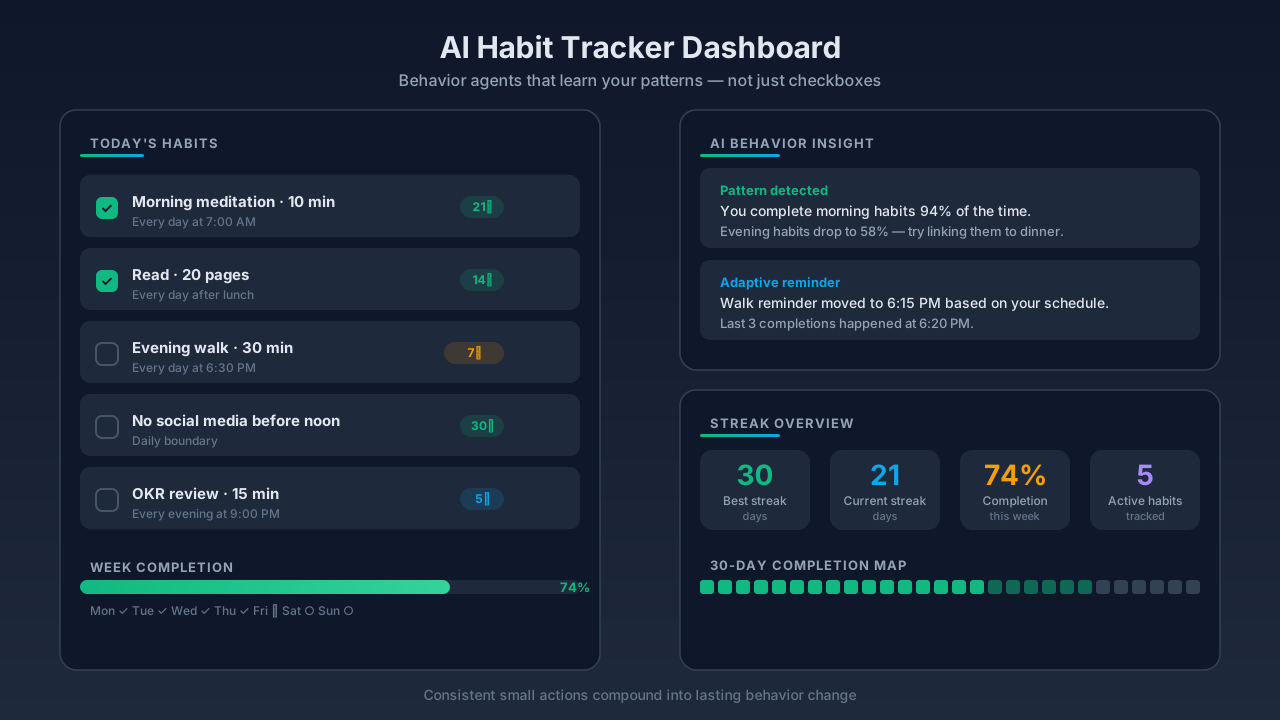
- Behavior agents. Persistent memory. Multi-channel delivery. Adaptive reminders. These don't just count completions — they model your behavior over time.
Only the third category survives contact with a real life.
Persistent Memory Isn't a Feature — It's the Floor
The single biggest reason habit tools feel broken in 2026? Amnesia.
Once you've experienced persistent memory in a planning tool, a habit tracker that forgets what you did yesterday feels like a step backward. — BuffyAI
Think about it. You told the app last month that 6am runs don't work because your roommate showers at 5:55. You mentioned on Tuesday that you skipped meditation because a client call ran over. You snoozed the 8pm reading reminder seven days in a row.
If the tool can't recall any of that, it's just a nicer spreadsheet.
Real behavior agents use a three-layer memory model:
- Short-term context — what's happening right now, this week
- Episodic event log — what you actually did, when, why you bailed
- Semantic pattern learning — the underlying "you" the system slowly gets to know
That architecture is what enables long-term behavioral coaching that adapts based on actual patterns, not just aggregated dashboards. Without it, every Monday feels like meeting a stranger who thinks you're a beginner.
Multi-Channel Delivery Is the New Filter
Here's a quiet killer. If a habit tool only reaches you through iOS push notifications, a significant chunk of users will pass on it — and they should.
This isn't about breadth of integrations. It's about a specific behavioral insight: habits need to reach you where your attention is, not where your phone happens to be. — BuffyAI
Be honest with yourself for a second. Where is your attention at 3pm on a Wednesday? Slack. Email. WhatsApp. A browser tab. Not a habit app icon buried on page three of your home screen.
A behavior agent meets you in those places. SMS. Email. Slack DM. Calendar blocks. Widgets. The channel matters more than the UI.
Adaptive Reminders Need to Be Response-Aware
This is where most tools still fail. They check your calendar, see you're "free," and ping you. But free ≠ responsive.
Someone who is technically free at 8am but consistently snoozes the 8am habit needs a different time — not a calendar-aware one, but a response-aware one. — BuffyAI
Your calendar shows when you're available. Your behavioral history shows when you actually respond. Those are different things.
A real behavior agent watches the done/snooze/skip pattern and shifts the reminder window until it lands in a slot you actually convert. No human coach is doing this math manually. AI is the only thing that can.
Recovery-First UX Replaces Streak Shame
Old model: you miss a day, the streak dies, the red number mocks you, you feel shame, you quit.
Think about how stupid that is as a design choice. The moment you most need support, the app punches you in the face with a 0.
2026 tools are shifting:
Reminders are expected to shift into recovery-first UX, not streak shame. — BuffyAI
Missed your morning run? A behavior agent says: "You've got 20 minutes at 4:30pm today. Want to move it there?" Not: "Streak: 0. Start over." One of those keeps you in the game. The other sends you back to Netflix.
But the Core Problem Didn't Change
Here's the part nobody wants to admit. Even with all this AI, most habit systems still fail after 2–3 weeks.
The tools changed; the core problem didn't. Habit systems fail when the friction of using the system exceeds the value it provides. — BuffyAI
Every tap, every setup, every "rate your mood" prompt is friction. If the tool takes more from you than it gives, you're out. AI doesn't save you from that math. It just changes the equation — if it's built right.
The Identity Move That Changes Everything
The most underrated finding in habit research has nothing to do with tech.
Research shows that the most lasting habits are tied to identity rather than outcomes. Rather than "I want to exercise," successful habit formation focuses on "I am someone who exercises." — Calmops, 2026
Outcome-based habits crumble the second the outcome gets delayed. I want to lose 10kg. Scale won't move for two weeks? Quit.
Identity-based habits survive the gaps. I'm a runner doesn't disappear because of one missed day. You just... run tomorrow. Because runners run.
The best behavior agents write this into the experience. They reframe your tracking as evidence of who you're becoming, not points you owe the app.
The 5-7 Habit Ceiling
One last thing before you go rebuild your whole life. Don't.
More than 5-7 habits leads to cognitive overload and reduced completion rates across the board. Quality over quantity. — Calmops
If you're starting fresh, pick 2–3 habits. Maximum. Anything more and your brain starts triaging — which really means dropping them all.
So What Do You Actually Do Now?
Close this tab. Open whatever habit tool you have. Ask three questions:
- Does it remember what I did last week and why?
- Can it reach me somewhere other than iOS push?
- When I miss, does it help me recover or just shame me?
Three yeses: you've got a behavior agent. Keep going. Any no: you've got a checkbox with marketing. It's not you — the tool is built on 2022 assumptions.
Pick 2 habits. Tie them to an identity ("I'm someone who moves daily," "I'm someone who sleeps like an adult"). Set them up in a tool that actually models you. Give it 30 days.
A year from now, you'll either be three habits deep into a new identity — or back here reading another article just like this one.
Your call.
Related Articles
View all →
AI Life Coach Apps: Do They Actually Work? What the 2026 Research Really Says
You open the app. It asks how your week went. You dump your thoughts. It reflects them back in tidy bullet points, suggests a SMART goal, se…

How AI Is Changing Personal Development in 2026 (And What It Means for You)
Ten years ago, personal development meant a stack of self-help books, maybe a podcast, and if you were lucky, a $200/hour coach who had time…

AI Productivity Tools That Actually Save Time in 2026 (Not Just Promise To)
You installed ChatGPT. Then Notion AI. Then Perplexity. Then three Chrome extensions your LinkedIn feed swore would change your life. It's A…