How to Run Your Life Like a Startup Without the Burnout


How to Run Your Life Like a Startup Without the Burnout
72% of entrepreneurs self-report mental health concerns. That's from a University of California, Berkeley study cited by Forbes — and it's the quiet cost of the advice everyone keeps pushing: treat yourself like a CEO, run your life like a business, optimize everything.
You did that. You built the morning routine. Color-coded the calendar. Started tracking your sleep, your workouts, your reading habit. And six months in? You're exhausted. Irritable. Working 16-hour days on your own life because treating yourself like a startup made you work harder at being you.
That's not a system problem. That's a design problem.
The Real Reason You're Burning Out
Here's the part nobody wants to say out loud. Most "run your life like a business" advice is the personal-development version of offering mindfulness webinars to overworked employees. It tries to fix the worker. Not the work.
According to MIT Sloan Management Review, managers focus on fixing the person — productivity tips, boundary advice, mindfulness training — "but these do little to resolve stress caused by long hours and unreasonable workloads." Translate that to your life: another habit tracker won't save you from a schedule you built wrong in the first place.
Burnout isn't a character flaw. It's structural.
"Jobs with positive characteristics — autonomy, variety, social support — lead to higher satisfaction, motivation, and performance. Minimizing harmful characteristics like excessive time pressure prevents burnout."
So before you add one more optimization, ask: am I running a startup I actually want to work at? Or one I'd quit if someone else were running it?
Run Your Life Like a Business — The Right Way
Don't throw out the whole idea. The people who do treat life like a business pull away from the ones who don't. Fast.
Matt Nawrot puts it bluntly: people who don't run their lives like businesses "eat junk food, buy unaffordable items, waste time on momentary pleasures." People who do run their lives like businesses "take courses, upgrade skills, read, network, buy productivity tools, eat healthy, workout, and invest in appreciating assets."
That's the upward spiral. SMART goals. Repeatable processes. A few KPIs you actually look at. Money you manage instead of manage around. Skills you keep sharpening.
But here's what the Twitter quote-tweets leave out. A company that chases revenue without a mission goes bankrupt in 18 months. A person who runs their life like a business without a reason to exist burns out in roughly the same amount of time.
Purpose Isn't Soft. It's The Most Important Input.
This is the part the hustle content skips.
According to a study in the Journal of Happiness Studies, participants with a stronger sense of purpose reported increased positive emotions — contentment, joy — and decreased negative emotions like anger and anxiety. Purpose isn't decoration. It's the emotional buffer that lets you absorb setbacks without quitting.
Michael Gervais — the performance psychologist — tells a story about an early mentor asking him, "Who are you?" Gervais tried to answer. The mentor cut him off: "Come back to me when you're ready."
Your business philosophy is what separates the people who sustain from the people who flame out. Not a Notion page of values. A real answer to: what do I stand for when no one's watching and nothing is on fire?
Without the philosophy, every optimization becomes optional. With it, the optimizations become obvious.
Work-Life Balance Is A Business Strategy
Yeah, I know what you're thinking. Balance is for people who aren't serious.
Read this and then decide.
According to CompareCamp research cited by Elevate Ventures, companies offering good work-life balance have 25% less employee turnover. 85% of companies that offer work-life balance opportunities report increased productivity. A Stanford University study found that work-life balance programs could lead to a 13% performance increase.
Now apply that to a company of one. You.
Rest is not the opposite of ambition. Rest is the compounding interest of ambition. Sleep-deprived founders ship worse code. Overworked creators produce worse content. Burned-out operators make worse decisions. None of that is debatable anymore. It's in the numbers.
The Four Triggers Of Entrepreneurial Burnout
You can't prevent what you can't name. Mindworx Hypnotherapy lists the four primary triggers of entrepreneurial burnout:
- Long working hours
- High levels of responsibility
- Financial uncertainty
- Lack of work-life balance
All four apply to running your life like a startup. Be honest with yourself for a second. Which ones are yours?
Early warning signs are just as predictable: chronic fatigue, irritability, trouble concentrating, loss of motivation, physical symptoms you've been ignoring. If two or three of those are showing up this month, you don't need another productivity hack. You need a redesign.
Two Frameworks That Work In Real Life
Enough theory. Two tools you can steal today.
1. NPV Thinking For Life Decisions
MonkWealth borrows the corporate finance rule: Net Present Value. Present value of all inflows minus all outflows. Consider only projects with positive NPV. For mutually exclusive projects, choose the one with the highest NPV.
Translate this to your life. That meeting that drains you? Run NPV on it. That course you've been "going to take for two years"? Run NPV. That friendship that only takes? NPV. The math strips the emotion. You stop confusing busy with building.
2. The Plus/Minus/Equal Model
Frank Shamrock's relationship framework. You need three types of people in your life:
- Plus — someone more successful than you. A mentor. Someone whose level you're trying to reach.
- Minus — someone you can teach. Teaching clarifies your own thinking and reminds you how far you've come.
- Equal — a peer for mutual feedback. Someone who calls you on your BS because they're in the same trenches.
A lone wolf will not make it. That's not motivational — that's logistical. Remove the toxic influences. Add the three roles. Watch the quality of your decisions change.
Daily Urgency Beats Daily Overload
Here's the trap. When you realize how much you want to do, the first instinct is to cram more into every day. That's how you burn out by June.
The antidote is urgency, not volume.
Jesse Itzler — entrepreneur, ultra-runner — calculates the average life expectancy of a Caucasian male and subtracts his current age. He knows, roughly, how many days he has left. That's urgency.
Jason Feifer, editor-in-chief of Entrepreneur, ends every hour with one question: "Would my family be proud of how I lived in the last 60 minutes?"
Neither is about doing more. Both are about choosing what goes into the hour. A startup measured by revenue will chase revenue. A life measured by hours spent on what matters will spend more hours on what matters.
The Redesign, Not The Grind
If you take one thing from this, take this: you can't run your life like a startup without burnout by working harder. You have to work differently.
Structure before strategy. Purpose before process. Balance as a feature, not a reward.
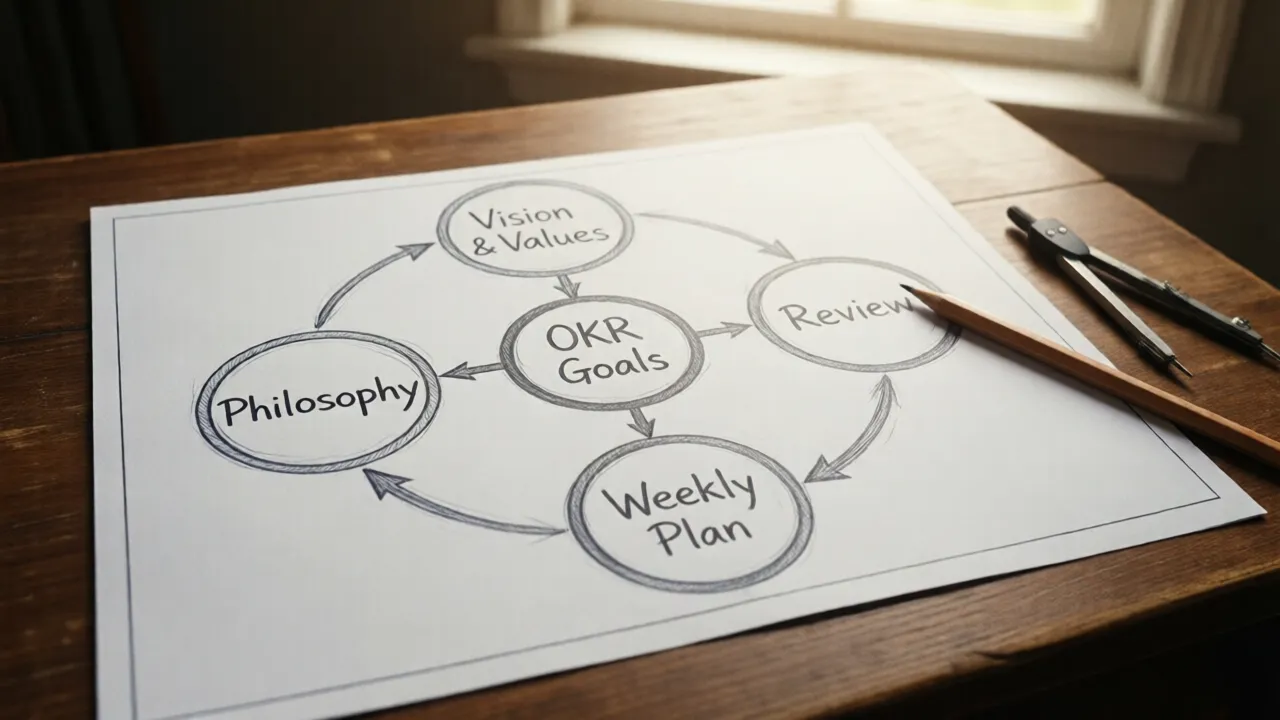
This is exactly why IdealWeek exists. Not as another task app — as the operating system that forces the real questions. What do you actually want? Why? What measurable progress proves you're moving? Your Dream Factory stores the vision and philosophy. The OKR Engine sets weighted key results so your priorities match your life NPV. The Execution Planner schedules the work — and the rest — so you're designing the week before the week designs you.
So What Are You Going To Do About It?
Pick up your phone. Right now.
- Write one sentence that answers: what do I stand for? One sentence. Not a manifesto.
- Open your calendar. Find three hours this week that serve that sentence. Lock them in.
- Pick one thing on your plate that has negative NPV. Cancel it. Today.
That's it. That's the starting line.
A year from now, you'll either be running a life you designed — or you'll be reading another article just like this one, still exhausted, still wondering why the system isn't working.
It's not the system. It's the design.
Related Articles
View all →
AI Habit Tracking in 2026: Why Behavior Agents Are Replacing Habit Apps
You downloaded the app on a Sunday night. Full of ambition. Meditate, read, run, no phone after 9pm. The first week felt amazing — green che…

AI Life Coach Apps: Do They Actually Work? What the 2026 Research Really Says
You open the app. It asks how your week went. You dump your thoughts. It reflects them back in tidy bullet points, suggests a SMART goal, se…

Anti-Hustle Culture: What It Means and Why It's Growing in 2026
Here's a number that should stop you mid-scroll.