How to Stop Being Busy and Start Being Productive (The Honest Playbook)

How to Stop Being Busy and Start Being Productive (The Honest Playbook)
It's 5:12pm. You're exhausted. You had back-to-back meetings, cleared 47 emails, hopped between four projects, said yes three times you shouldn't have. You sit down to look at your to-do list. The one thing that actually mattered today? Untouched.
You weren't lazy. You were busy.
And here's the uncomfortable research:
The average US knowledge worker loses 127 hours annually to distraction — and leaders lose 683 hours. — Superhuman, 2026
Executives waste 8 to 12 hours every week on email that doesn't move their business forward.
That's not a time problem. It's a direction problem. You're confusing motion with progress.
This article is the honest playbook for fixing that. No "5 morning habits of millionaires." Real mechanisms, real research, real moves you can make this week.
The Trap Nobody Wants to Name: Motion vs Action
James Clear put this better than anyone:
Motion makes you feel like you're getting things done. But really, you're just preparing to get something done. — James Clear
Motion is: researching the gym. Reading the diet book. Picking the perfect productivity app. Organizing your Notion. Planning the plan.
Action is: doing the workout. Eating the meal. Writing the thing. Making the call.
Motion feels like action. That's why it's dangerous. Your brain can't tell the difference in the moment.
Motion (Busyness): Planning, strategizing, and learning. It feels like progress, but it produces no result. Action (Effectiveness): The behavior that delivers an outcome. — Formal Psychology
Check your last week. Ask honestly: what percentage was motion? For most of us, it's terrifying.
Why Your Brain Picks Busy Every Time
Here's the part that makes it hard. Your brain isn't just confused by busyness. It's addicted to it.
Every time you tick off a small task — reply to an email, schedule a meeting, reorganize a folder — you get a dopamine hit. It's small, but it's immediate.
The work that actually matters? The dopamine for that is delayed by weeks or months. Your primitive brain can't wait that long.
Our primitive brains prioritize the immediate dopamine hit of the trivial task over the long-term satisfaction of the significant task. — Formal Psychology
This is the mere urgency effect (documented in the Journal of Consumer Research). We consistently choose urgent tasks over important ones, even when the urgent ones don't matter.
And then there's the part that really stings:
Most of us are experts at avoiding criticism. [...] The biggest reason why you slip into motion rather than taking action: you want to delay failure. — James Clear
Motion is safe. You can't fail at planning. You can only fail when you ship something. So your brain, terrified of judgment, keeps you perpetually planning.
That's the trap. You have to name it to break it.
The Cost of Context Switching Is Higher Than You Think
One more reason you're drowning. Multitasking.
Except — you're not multitasking. Your brain doesn't do that. It's context-switching, fast, at a massive cost.
Up to 40% of productive time can be consumed by the mental blocks and cognitive reconfiguration required for switching. — peer-reviewed research, via Superhuman
40%. Nearly half your day, gone to toggle tax.
Constant interruptions cost 23 minutes of recovery time per disruption.
Every Slack ping. Every "quick question." Every pop-up. 23 minutes of real focus lost. Now count your pings today. Still wondering why nothing deep got done?
The 80/20 You Keep Ignoring
Pareto's Principle is so over-quoted it's almost embarrassing to cite. But it keeps being true:
80% of results come from 20% of efforts. — Pareto Principle
Most people spend their time on the 80% that feels urgent but yields almost nothing. The 20% that actually moves the needle? It gets squeezed into stolen hours on Sunday nights.
Flip it. The 20% gets the morning. The 80% gets the scraps.
Deep Work: The Antidote
The concept is Cal Newport's:
Professional activities performed in a state of distraction-free concentration that push your cognitive capabilities to their limit. — Cal Newport, via BlogTPoint
And the numbers back it:
Research shows [2+ hour uninterrupted] periods drive 80% of meaningful output. — productivity research
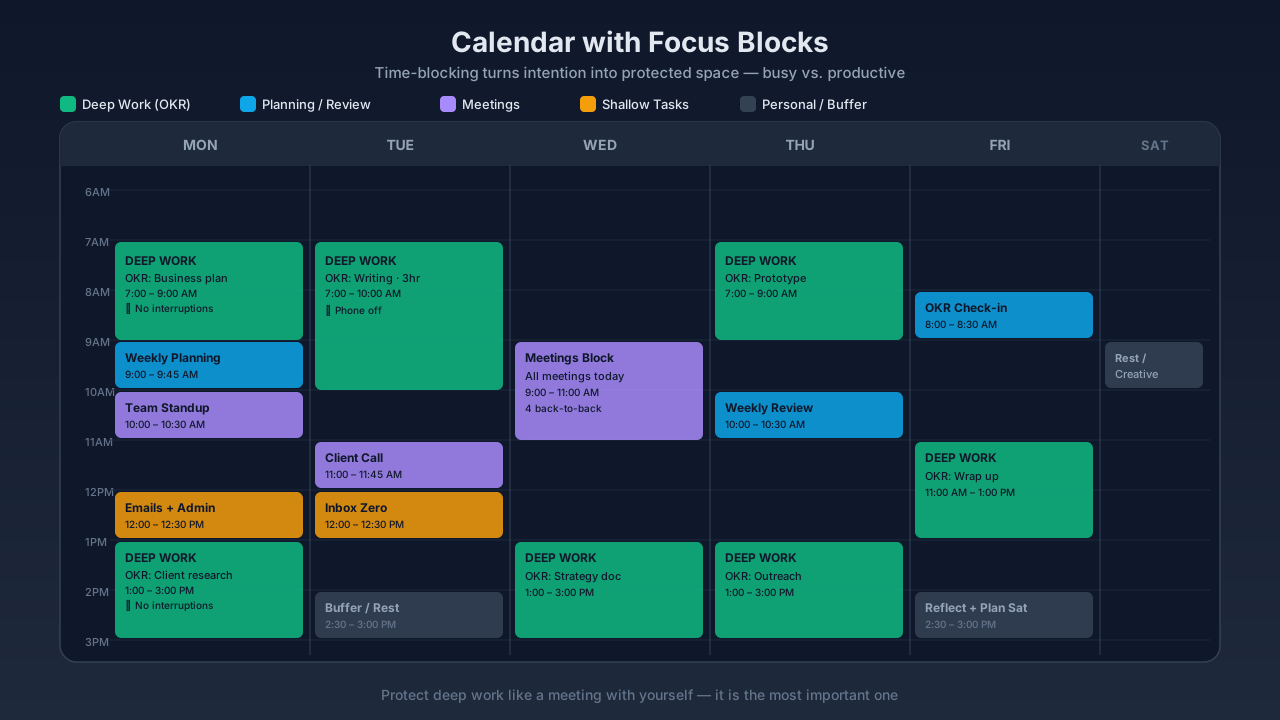
Two hours. Undisturbed. That's the unit of real work. Anything shorter gets eaten by setup costs. Anything more interrupted gets eaten by context switching.
If you can't find two uninterrupted hours somewhere in your week, you don't have a productivity problem. You have a scheduling problem. Fix the schedule.
Clear Goals Make Busyness Impossible
Here's the fastest cure for reactive busyness: know what the hell you're trying to do.
Companies that implement people-focused performance management with clear goal-setting are 4.2 times more likely to outperform their peers and achieve an average 30% higher revenue growth. — Superhuman research
Employees who strongly agree they know what is expected of them are 47% less likely to experience frequent burnout. — Gallup
47% less burnout. Just from clear goals. That's not a productivity hack. That's a quality-of-life revolution.
The fastest test: write down — right now, no app — the one outcome you're trying to hit this week. If you stumble, hesitate, or write a generic "be productive"… that's the problem. You're busy because you haven't decided what to be productive at.
Energy Management > Time Management
Here's the 2020s update to productivity thinking. Time management is solved. Everyone has the same 168 hours. The people pulling ahead are managing energy, not hours.
When 141 companies across six countries reduced hours in the largest four-day workweek trial, productivity was maintained or improved. — four-day workweek trial, via Superhuman
Less time. Same or more output. Why? Because workers made fewer mistakes, focused harder, rested better.
You don't need more hours. You need your peak hours to go to peak work.
Peak cognitive capacity typically occurs in the morning for most people.
If your mornings are email and meetings, you are literally burning your best hours on your worst tasks. Steal them back.
The Prioritization Shift
Prioritization isn't a to-do list. It's a kill list.
Deciding what not to do is as important as deciding what to do. — Steve Jobs
What is important is seldom urgent, and what is urgent is seldom important. — Dwight D. Eisenhower
Two rules for your own prioritization:
- Identify the one outcome for the week. Not three. Not five. One.
- Kill, delegate, or defer everything that doesn't move it.
That's it. That's the skill. Everything else — Eisenhower matrix, MoSCoW, RICE — is just sophistication on those two moves.
The Metrics You Track Shape Your Behavior
One more flip:
Hours worked, emails sent, and meetings attended measure activity, not achievement. — Superhuman research
Most people track activity. That's why they stay busy.
Track these instead:
- Deep work hours — how many 2+ hour focused blocks did I actually get this week?
- Outcome shipped — did I finish the one thing that mattered?
- Decisions made — did I resolve the questions that were blocking me?
- Energy level — start and end each day. Pattern matters.
You become what you measure. If you measure activity, you become a busy person. If you measure outcomes, you become a productive one.
The 2026 Playbook: Monday Action Plan
Stop. I want this to actually happen for you. Here's the concrete version.
Sunday night (15 minutes):
- Write down the one outcome for the week.
- List the 3 most important sub-tasks that move it.
- Block 2 hours of deep work on Monday, Tuesday, Wednesday morning — on the calendar, named, no reschedule.
- Identify 2 recurring meetings or commitments to kill or delegate.
Monday morning (before anything else): 5. Phone in another room or on DND. 6. Go to your first deep work block. 7. Work on ONE sub-task from yesterday's list. 8. No email, Slack, or browser tabs.
Every evening (3 minutes): 9. One question: "Did I do motion or action today?" 10. Write one sentence of the answer. No judgment. Just notice.
Friday end-of-day (10 minutes): 11. Review: did the one outcome move forward? 12. What was motion this week that I can cut? 13. Next week's one outcome. Write it.
That's it. Four touch points. Maybe 45 minutes total. And it will compound faster than any productivity app you've tried.
Where This Fits in a Bigger System
The weekly ritual above is the floor. The ceiling is connecting that weekly outcome to something bigger — a quarterly objective, a yearly goal, a multi-year vision. Otherwise you'll solve the "busy vs productive" problem locally and still drift globally.
This is exactly the gap IdealWeek was built for — vision → OKRs → weekly execution in one system, so the thing you pick as "this week's one outcome" is actually connected to who you're trying to become. But even without a tool, the principle is the same: every weekly priority should be answerable to a quarterly one.
Produce weekly. Align quarterly. Review yearly.
Do This Right Now
- Look at your calendar for tomorrow.
- Find 90 minutes in the morning that's currently "open" or fillable with meetings.
- Block it. Name it: "Deep work on [the one outcome]."
- Decline or reschedule any meeting that lands on top of it.
- Tonight, put your phone in a different room to charge.
You just bought yourself the single most valuable thing in 2026: uninterrupted time on work that matters.
A year of Mondays like that? You're a completely different person.
Or — you can keep being busy.
5:12pm tomorrow will tell you which one you chose.
Related Articles
View all →
Best AI Focus and Distraction Blocking Apps in 2026 (Tested, Ranked, Honest)
It's 3:17 PM. You were deep into a task at 2:45. You glance at your phone for "one second." Instagram. A reel. Another reel. A DM. A text. B…
Best Apps for Deep Work and Focus in 2026: Distraction Blockers, Flow State Tools, and More
You don't have a focus problem. You have an environment problem.

Focus Mode Apps With AI in 2026: How Smart Distraction Blocking Actually Works
You sit down at 9:00 to write the thing. You glance at your phone at 9:04. Three reels later, it's 9:22 and you don't remember deciding to o…