The OKR Framework Explained: How John Doerr's Goal-Setting System Actually Works


The OKR Framework Explained: How John Doerr's Goal-Setting System Actually Works
You've set goals before. Probably dozens of them. New Year's resolutions. Quarterly targets. That fitness plan you wrote out on a Sunday night and forgot by Wednesday.
And you know what happened? Nothing. Or worse — something started, then quietly died.
You're not alone. According to research on goal-setting behavior, roughly 92% of people who set goals never achieve them. Not because the goals were bad. Because the system was missing.
That's the gap the OKR framework was built to close. Not another motivational trick. Not a prettier to-do list. A genuine operating system for turning ambitious objectives into measurable outcomes — the same one that scaled Google from 40 employees to 190,000+.
So let's break it down. What OKRs actually are, where they came from, how the scoring works, and how to write your first set today.
What Is the OKR Framework?
OKR stands for Objectives and Key Results. The formula is deceptively simple:
"I will [Objective] as measured by [Key Results]."
That's it. One sentence. But inside that sentence is a philosophy that separates wishful thinking from real progress.
- Objectives are qualitative and directional. They answer: What do I want to achieve? They should be ambitious, clear, and a little uncomfortable.
- Key Results are quantitative and measurable. They answer: How will I know I'm getting there? As Google's former VP Marissa Mayer put it: "It's not a Key Result if it doesn't have a number."
Here's a quick example:
Objective: Get my physical health to a level I'm genuinely proud of.
- KR1: Run 5K in under 25 minutes by June 30
- KR2: Hit the gym 4x per week for 12 consecutive weeks
- KR3: Reduce body fat from 22% to 17%
Notice what's happening. The objective is inspiring and qualitative — it pulls you forward. The key results are brutally specific — they keep you honest. No wiggle room. No "I kinda worked out." You either hit 4x/week or you didn't.
That tension between ambition and measurement? That's the engine of the OKR framework.
The Origin Story: From Intel to Google
OKRs didn't start in a sleek Silicon Valley conference room. They started at Intel in the early 1970s, invented by Andy Grove — Intel's legendary COO and CEO.
Grove called his system "iMbO" (Intel Management by Objectives), a sharper evolution of Peter Drucker's Management by Objectives concept. He documented it in his 1983 book High Output Management. But the framework stayed largely inside Intel's walls.
Enter John Doerr. A young salesman at Intel, Doerr attended Andy Grove's internal OKR course in 1975 and was hooked. He later called Grove "the Father of OKRs" and himself "the Johnny Appleseed of OKRs" — the guy who carried the seeds everywhere.
In 1980, Doerr moved to venture capital firm Kleiner Perkins. By 1999, he'd become one of Silicon Valley's most influential investors. And one of his portfolio companies was a scrappy little startup called Google — 40 people, a conference room that doubled as a ping-pong table.
Doerr pitched OKRs to Larry Page and Sergey Brin, who were 24 years old at the time. Brin's response? "Well, we don't have any better way to manage the company so we might as well give this a try."
That "try" became Google's operating rhythm. Today, every single Googler — all 190,000+ of them — writes quarterly personal OKRs aligned to company annual OKRs. They're posted on an internal website that anyone can see, tracked, graded, then swept aside as a new cycle begins.
And here's the crucial part: Google doesn't tie OKRs to bonuses or promotions. They're used for something more powerful — collective alignment. A social contract that keeps 190,000 people pulling in the same direction.
How OKR Scoring Works: Why 70% Is the New 100%
Most goal systems reward 100% completion. OKRs flip that on its head.
Key results are scored on a 0 to 1.0 scale (or 0-100%), with a traffic light system:
- Green (0.7-1.0): Target achieved. You stretched and delivered.
- Yellow (0.4-0.69): Partial achievement. Progress happened, but something fell short.
- Red (0-0.39): Missed. Time to diagnose why.
John Doerr's famous line: "70 percent is the new 100 percent."
Why? Because OKRs are supposed to be stretch goals — ambitious enough that hitting 70% still means you accomplished something remarkable. If you're consistently scoring 1.0 across the board, your goals aren't ambitious enough. You're sandbagging.
Larry Page nailed it: "If you set crazy, ambitious goals and miss them, you'll still achieve something remarkable."
This is a mindset shift. Most people set safe goals to protect their ego. OKRs ask you to set goals that make you slightly nervous — and then celebrate 70% as a win.
How to Write OKRs That Actually Work
Here's where most people mess up. They confuse OKRs with to-do lists, KPIs, or vague intentions. Let's fix that.
The Rules
- 3-5 objectives max. Focus is the point. If everything is a priority, nothing is.
- 2-4 key results per objective. Enough to measure progress, few enough to actually track.
- Objectives are qualitative. No numbers in your objective. That's what key results are for.
- Key results are measurable. If you can't put a number on it, it's not a key result.
- Set them quarterly. Annual goals are too distant. Weekly goals are too tactical. Quarterly OKRs give you the right blend of urgency and breathing room.
A Personal OKR Example
Objective: Build a side business that generates real revenue.
- KR1: Launch MVP product by March 15
- KR2: Acquire first 50 paying customers by end of Q1
- KR3: Generate $2,000 MRR by March 31
See how each key result is specific, time-bound, and measurable? No room for "I kinda worked on it." You either have 50 customers or you don't.
OKR Templates to Get You Started
One of the biggest hurdles with OKRs is the blank page. You know the framework, but staring at an empty document wondering "what should my objective even be?" kills momentum fast.
That's why templates matter. Here are patterns that work across common life areas:
Health & Fitness:
- O: Reach peak physical condition this quarter
- KR1: Complete 48 workout sessions (4x/week for 12 weeks)
- KR2: Run a 5K in under 24 minutes
- KR3: Sleep 7+ hours on 80% of nights
Career Growth:
- O: Become the go-to expert in my field
- KR1: Publish 6 thought leadership articles
- KR2: Speak at 2 industry events
- KR3: Grow professional network by 200 meaningful connections
Financial Freedom:
- O: Build a financial safety net that eliminates stress
- KR1: Save $5,000 in emergency fund
- KR2: Pay off $3,000 in high-interest debt
- KR3: Set up automated investing of $500/month
IdealWeek's OKR Engine comes with hundreds of pre-built templates like these — categorized across Improve, Promotion, Family, Business, and more. Each template includes pre-defined key results and action checklists, rated by other users. You pick one, customize it, and you're executing in minutes instead of spending hours designing your own system from scratch.
And if templates feel too rigid, IdealWeek's AI-assisted OKR creation lets you type a plain-language idea — like "Start a side business" — and generates a complete Objective with Key Results, timelines, and suggested actions in seconds.
The CFR Framework: The Human Side of OKRs
OKRs handle the "what" and "how." But Doerr realized something was missing — the "why" and the human connection. So he introduced CFRs: Conversations, Feedback, and Recognition.
Conversations: Regular check-ins. Not annual reviews — weekly or bi-weekly discussions about progress, blockers, and direction. Thomas Petite, writing about Measure What Matters, recommends a dual cadence: 15-30 minute weekly reviews plus monthly deep dives.
Feedback: Two-way, not top-down. The person doing the work often knows what's broken before anyone else does. Create space for that.
Recognition: Celebrate progress, not just completion. Someone who hit 0.7 on an audacious goal deserves more recognition than someone who hit 1.0 on a safe one.
CFRs are what keep OKRs from becoming a cold spreadsheet exercise. They add the warmth, the accountability, and the motivation that make the system stick.
Quarterly OKRs: Why 90 Days Is the Sweet Spot
Why quarterly? Because annual goals become stale — market shifts, life happens, priorities change. And weekly goals are too tactical to drive meaningful transformation.
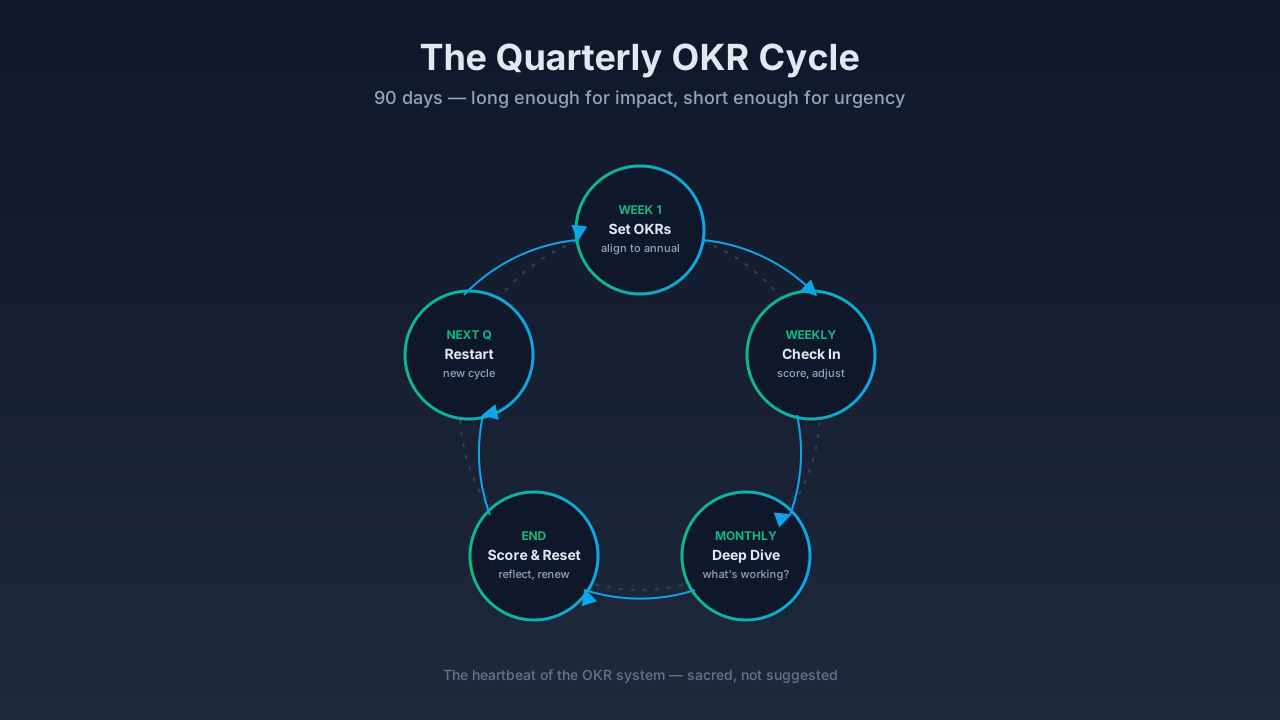
Quarterly OKRs hit the sweet spot. Ninety days is long enough to achieve something substantial but short enough to maintain urgency. Here's the rhythm:
- Week 1: Set your quarterly OKRs. Align them to your annual direction.
- Weekly: Check in. Update scores. Course-correct if needed.
- Monthly: Deep dive. What's working? What's not? Do any key results need adjusting?
- End of quarter: Score, reflect, reset. Don't carry over failed OKRs blindly — re-evaluate whether they still matter.
The companies and individuals who get the most out of OKRs treat the quarterly cycle as sacred. It's not a suggestion. It's the heartbeat of the system.
OKRs vs. KPIs: Know the Difference
People confuse these constantly. Here's the quick distinction:
- KPIs measure ongoing performance. They're the dashboard lights on your car — speed, fuel, temperature. They tell you how things are running.
- OKRs drive change. They're your destination. Where are you going, and how will you know when you arrive?
A sales team might have a KPI of "respond to leads within 4 hours." That's operational. Their OKR might be "Break into the enterprise segment" with key results around landing 3 enterprise accounts and increasing average deal size by 40%.
KPIs keep the lights on. OKRs take you somewhere new.
The Operation Crush Story: OKRs in Action
Want proof that OKRs work under pressure? Go back to Intel, 1979.
Motorola had just released the 68000 microprocessor — a chip that completely outclassed Intel's 8086. Regional sales managers were calling Andy Grove's office in panic. Intel was getting crushed.
Grove couldn't compete on engineering — chip development takes years. So he launched "Operation Crush" — a radical restructuring of Intel's sales operation built on OKR principles. He created Crush Teams: autonomous groups of salespeople given complete independence to own their Objectives and hit their Key Results however they saw fit.
The result? Crush Teams pivoted Intel's strategy from selling to programmers (who knew the 68000 was technically superior) to selling to CEOs (who cared about relationships, trust, and ecosystem). They adapted on the ground in real-time — something Motorola's rigid hierarchy couldn't match.
One of the customers they won? IBM. And IBM used Intel's chips to build something they called a "Personal Computer."
By 1983, Intel's revenue went from $660 million to over $1 billion. By 1990, $3 billion. The chip wars were over.
That's OKRs. Not just a planning tool. A competitive weapon.
Start Your OKR Framework Today
You've read the theory. You know the history. Now here's the part where most people close the tab and do nothing.
Don't be most people.
Here's your move: Open IdealWeek. Go to the OKR Engine. Pick one objective — just one — that genuinely matters to you this quarter. Write two or three key results with real numbers attached. Set your first weekly check-in.
That's it. That's how Google started. That's how Intel beat Motorola. Not with a 47-page strategic plan. With one clear objective and a handful of measurable results.
Your OKR framework doesn't need to be perfect. It needs to exist.
The Takeaway: John Doerr didn't invent OKRs — Andy Grove did. But Doerr proved that the framework scales from a 40-person garage startup to a 190,000-person global company. The formula is simple: ambitious objective + measurable key results + quarterly rhythm + honest scoring. That's the entire system. The only question left is whether you'll use it or just read about it.
Related Articles
View all →
Best AI Goal Setting Apps in 2026: The Honest, Data-Backed Ranking
"Launch a side business by year-end."

How to Use AI to Set and Track OKRs in 2026 (The Real Playbook)
Q1 kicked off with three ambitious OKRs. It's April. You couldn't find last quarter's doc if you tried. The quarterly review is next Tuesday…

Notion Life OS vs Dedicated Goal Apps: Which Is Better for Execution in 2026
You saw the template on TikTok. You paid $49. You spent a Saturday building the Notion Life OS of your dreams — OKR database, habit tracker,…