
Best AI Goal Setting Apps in 2026: The Honest, Data-Backed Ranking

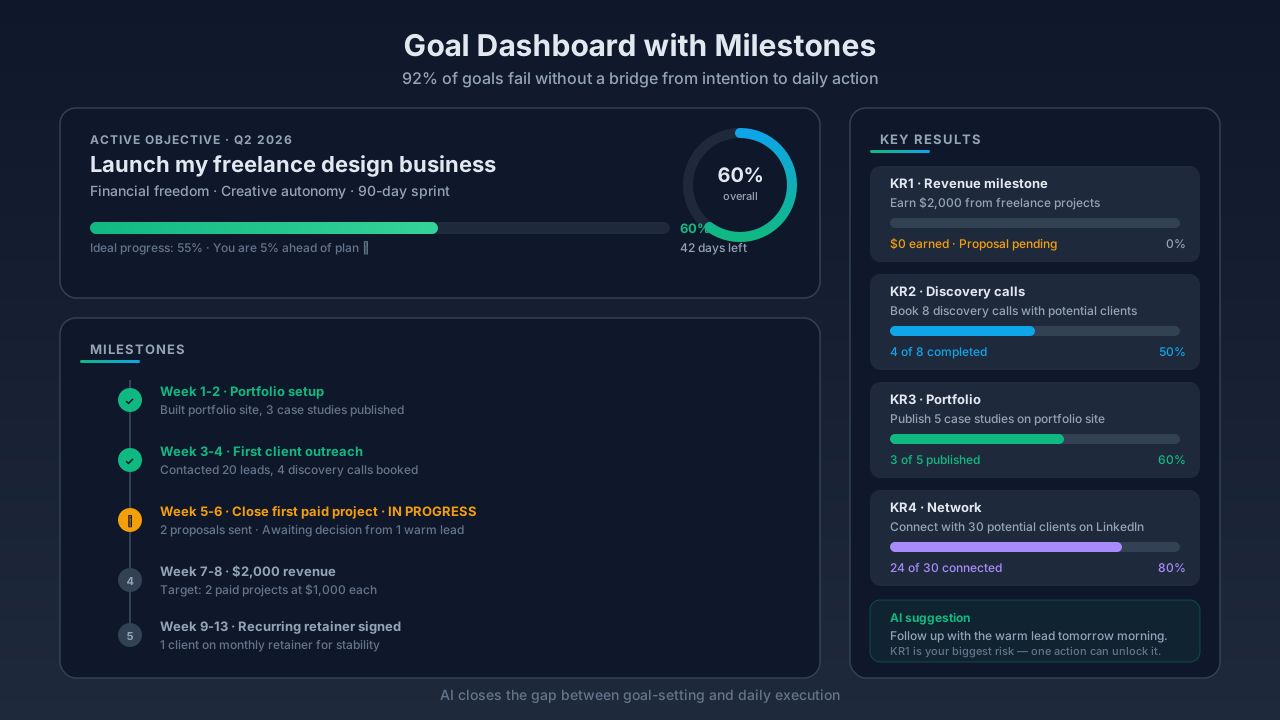
Best AI Goal Setting Apps in 2026: The Honest, Data-Backed Ranking
"Launch a side business by year-end."
You wrote it in January. It's April. You're still in "planning mode." You bought the domain. You have 4 tabs open about logo design. You haven't shipped anything.
Here's what separates the people who actually finish from the ones who keep "planning":
92% of goals fail: most people set goals without connecting them to daily behavior. — Beyond Time
Ninety-two percent. Your brain doesn't fail because your goal is wrong. It fails because the goal lives in a Notion page and your life lives on a calendar, and the two never actually touch.
In 2026, AI goal-setting apps exist specifically to bridge this gap. Some of them work shockingly well. Some are just chatbots with a streak counter.
Here's the honest ranking — based on what the research actually shows, not what the app store says.
First, The Numbers That Matter
Before picking a tool, know what moves the needle.
Research from Dominican University shows that people who write structured goals are 42% more likely to achieve them than those who simply think about what they want. — Beyond Time
Just writing them. Structured. Not "I want to be healthier" but "Run 3x/week, 30 minutes, 8 weeks." That alone gets you +42%.
Then there's SMART:
A study involving university students found that those who applied the SMART framework reported higher levels of goal attainment (~73%) compared to those who did not (~64%). — ClickUp, 2026
A nine-point jump from using a framework that takes ten minutes to learn.
And AI coaching is where it gets wild:
GoalsOnTrack's AI coach has been shown to improve goal completion rates by 83% by making adjustments based on performance. — Goalzen
83%. Not "a bit." Not "somewhat." Close to a doubling of your hit rate. Similar patterns elsewhere:
Rhythm Systems applies predictive analytics to evaluate performance metrics, crafting customized strategies that improve goal achievement rates by 50%. — GoalMentor
Microsoft 365's AI coaching system encourages biweekly reviews, boosting goal completion by 40%. — GoalMentor
The pattern is clear. Structure + SMART + AI feedback loop = materially different outcomes.
Now — which tool gives you all three without being a productivity rabbit hole?
What a 2026 AI Goal App Actually Needs to Do
Kill the checklist. A real AI goal app in 2026 should:
- Take a messy ambition ("launch a side business") and structure it
- Break it into SMART key results or milestones with deadlines
- Connect milestones to daily/weekly actions — not just reminders
- Track progress with real data, not just check-marks
- Adjust the plan based on how you're actually performing (this is the AI part)
- Have one honest mirror moment per week — where it tells you you're off
Anything less is a fancy to-do list.
The 2026 Ranking
🥇 Beyond Time — Best Overall for Personal Goals
Beyond Time won 2026 for one reason: it doesn't start with tasks.
Beyond Time takes a fundamentally different approach from most productivity apps: instead of starting with tasks or calendars, it starts with what you want to achieve and works backward to daily action. — Beyond Time
That's the correct architecture. Most tools ask "what do you need to do today?" Beyond Time asks "what are you trying to become?" and works the calendar from there.
It uses AI to generate milestones from a plain-language goal. Then it builds habits connected to those goals. Then it surfaces them in your routine.
Best for: Personal ambitions, life design, multi-domain goals (career + health + relationships). Watch out for: Consumer-grade, not built for team/enterprise coordination.
🥈 ClickUp (with ClickUp Brain) — Best for Project-Style Goals
If your goals are more like projects — launches, outputs, deliverables — ClickUp Brain delivers.
ClickUp Brain generates SMART goals tailored to your objectives and show you the path to achieving them. — ClickUp
It hooks into 1,000+ integrations, gives you AI-generated progress summaries, and keeps your goal hierarchy visible inside the work itself. If your life and work happen in the same tool, this is hard to beat.
Best for: Side project launches, content creators, freelancers shipping things. Watch out for: Overkill for purely personal goals. The surface area is huge.
🥉 Motion — Best for Auto-Scheduling
Motion's pitch is aggressive: it won't just plan your goals, it'll schedule them into your calendar for you.
Its AI-powered scheduling feature optimizes your daily schedule by automatically prioritizing and time-blocking tasks on your calendar by deadlines and priorities. — HashDork
That's the productivity-for-the-chronically-overcommitted move. Goals + tasks + calendar, all auto-arranged. If you're the kind of person who always has more intentions than hours, Motion removes the planning step entirely.
Best for: Over-scheduled people whose bottleneck is calendar chaos, not ambition. Watch out for: You have to trust the scheduler. If you override it constantly, the AI never stabilizes.
Perdoo — Best for OKR Management
If you want to run your personal life like a small company, Perdoo is built for OKRs specifically.
The AI-driven goal-setting assistant is one of Perdoo's most distinctive features. It uses AI to analyze organizational data and suggest objectives that are consistent with the company's strategic direction. — HashDork
It's built for teams, but solo users who want hardcore OKR rigor can make it work. Quarterly cycles, weighted key results, the works.
Best for: Founders, team leads, disciplined OKR practitioners. Watch out for: Heavy. If you're not committed to OKRs as a methodology, this is too much.
GoalsOnTrack — Best for Pure Completion Rate
GoalsOnTrack doesn't have the prettiest interface in the world. What it does have is the best-documented AI coach for raw completion:
GoalsOnTrack's AI coach has been shown to improve goal completion rates by 83% by making adjustments based on performance. — Goalzen
83% lift is the highest in the category. The tool reviews your progress, adjusts the plan, nudges you back when you drift. If you don't care about aesthetics and care deeply about finishing, it's here.
Best for: Outcome-obsessed users. Watch out for: UI is utilitarian. You're not buying this for vibes.
IdealWeek — Best for Vision-to-Execution Integration
Most of the apps above nail one layer. IdealWeek connects all three: vision → OKRs → execution. It starts at life design (10-year vision down to quarters), runs a real OKR engine with weighted key results, and ties every key result to scheduled actions in a timeline-based planner.
Unlike generic task managers, it forces the right questions upfront — what do you actually want? why? what measurable progress will prove it? — before touching a to-do list. AI assists OKR creation from plain-language ideas, and behind-the-plan alerts compare your actual progress to the ideal pace so you know exactly when to course-correct.
Best for: Ambitious individuals who want a personal operating system, not just a goal tracker. Watch out for: Opinionated methodology. If you don't want to commit to OKRs, this isn't a blank canvas.
Quick Comparison
| App | Best For | AI Strength | Methodology |
|---|---|---|---|
| Beyond Time | Personal life goals | Goal-to-habit breakdown | Outcome-first |
| ClickUp Brain | Project-style goals | SMART generation, progress summaries | Work-integrated |
| Motion | Over-scheduled people | Auto-calendar scheduling | Task-to-time |
| Perdoo | OKR practitioners | Strategic OKR suggestions | OKR-native |
| GoalsOnTrack | Completion-obsessed | Performance-based coaching | Outcome-focused |
| IdealWeek | Vision-to-execution | AI-assisted OKRs + behind-plan alerts | Vision → OKR → Weekly |
Which One Should You Actually Pick?
Three filters, no bloat.
1. What's your bottleneck?
- "I have goals but they don't touch my daily life" → Beyond Time or IdealWeek
- "I have too many tasks, goals get crushed" → Motion
- "I need to run a quarterly OKR cadence" → Perdoo or IdealWeek
- "I start goals and never finish" → GoalsOnTrack
2. Is your life mostly personal or mostly work?
- Personal → Beyond Time, IdealWeek
- Work projects → ClickUp Brain
- Hybrid → IdealWeek or ClickUp
3. How much methodology do you want forced on you?
- A lot (OKRs, structured reviews) → Perdoo, IdealWeek
- A little (just AI + calendar) → Motion
- Somewhere in between → Beyond Time
Don't install three. Pick one. Give it six weeks.
The Brutal Truth About Goal Apps
Here's what every article about this skips: the app doesn't matter as much as the ritual.
The 40–83% completion lifts come from apps that force biweekly reviews, weekly check-ins, and adjustment cycles. If you download GoalsOnTrack and never do the review? You won't get 83%. You'll get 8%.
The AI gets you the lift. You have to get yourself to the review.
Do This Right Now
- Pick one goal that matters for the next 90 days. One.
- Write it SMART: specific, measurable, achievable, relevant, time-bound.
- Install one app from the list above.
- Break the goal into 3–5 key results inside the app. Give them deadlines.
- Schedule a recurring 20-minute review — same day, same time, every week.
- Put the first review on your calendar before you close this tab.
42% + 9% + 83% aren't numbers you get for signing up. They're numbers you get for showing up to the review for 12 straight weeks.
90 days from now, you'll either have the side business live — or you'll have more tabs open about logo design.
One of those is still on you.
Related Articles
View all →
How to Use AI to Set and Track OKRs in 2026 (The Real Playbook)
Q1 kicked off with three ambitious OKRs. It's April. You couldn't find last quarter's doc if you tried. The quarterly review is next Tuesday…

The OKR Framework Explained: How John Doerr's Goal-Setting System Actually Works
**You've set goals before. Probably dozens of them.** New Year's resolutions. Quarterly targets. That fitness plan you wrote out on a Sunday…

Notion Life OS vs Dedicated Goal Apps: Which Is Better for Execution in 2026
You saw the template on TikTok. You paid $49. You spent a Saturday building the Notion Life OS of your dreams — OKR database, habit tracker,…