The Avoidance Loop: Why Ambitious People Dream Big but Do Nothing


The Avoidance Loop: Why Ambitious People Dream Big but Do Nothing
You have the vision. You've written it down. You know exactly what you need to do next — start the project, send the application, open the blank doc and write the first sentence.
And instead you spend an hour reorganizing your desk. You pick up your phone. You watch a YouTube video about productivity. You scroll through someone else's highlight reel. By 11pm you've done everything except the one thing that actually matters.
It's not laziness. It's not a character flaw. There's a neurological cycle running in your brain right now — one that gets stronger every single time you give in to it. Procrastination researcher Tim Pychyl spent decades studying exactly this pattern, and what he found changes everything about how you should think about why you're stuck.
Procrastination Is Not a Time Management Problem
Here's the reframe that most people get wrong: procrastination has nothing to do with managing your time better.
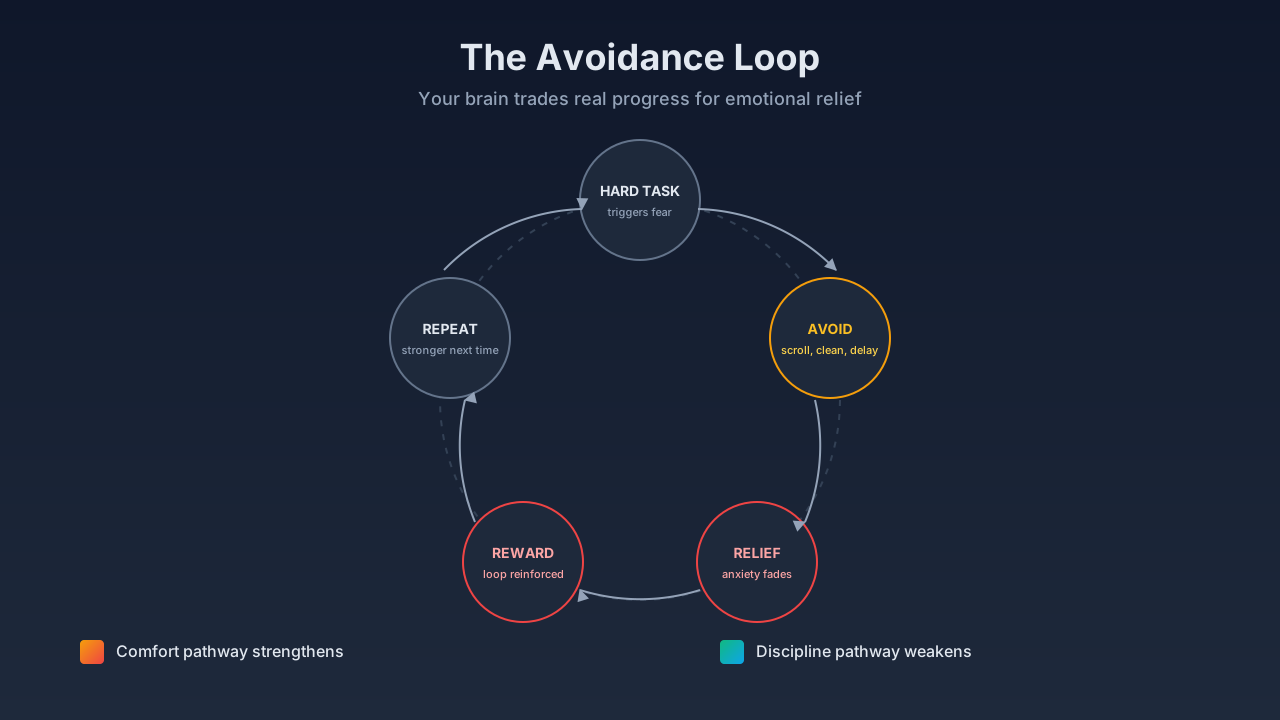
According to Pychyl's research, procrastination is an emotion regulation problem. When you think about doing something important — launching the side project, writing the essay, doing the workout — your brain generates a negative emotion. Self-doubt. Overwhelm. That gnawing fear that the result won't be good enough.
And your brain hates negative emotions. So it does what it's wired to do: escape.
You clean your room. You reorganize your notes. You pick up your phone and start scrolling. The dread disappears. You feel relief.
Here's the part nobody talks about: that relief is itself a reward. And in psychology, behaviors that get rewarded get repeated. Your brain just learned that avoiding hard things feels good. So it does it again. And again. And again.
This is the avoidance loop.
What's Actually Happening in Your Brain
Every time you face a hard task, two systems fight for control inside your skull.
The amygdala — your brain's alarm system. It scans for threats. And when a task feels overwhelming or scary, your amygdala treats it exactly like a physical danger. Run. Don't do this. This is going to hurt.
The dorsal anterior cingulate cortex (dACC) — the part that actually makes you act. It takes the fear signal from the amygdala, overrides it when needed, and pushes you to do the thing you're supposed to be doing.
When you procrastinate, the amygdala is winning. Neuroscientists call this an amygdala hijack — your emotional brain straight-up overrides your rational brain, and you flee from the task like it's a predator.
But here's what makes it dangerous. As cognitive scientist Olga Loiek explains: every time you go through the avoidance loop, you're physically strengthening the neural pathway for procrastination. The procrastination circuit gets faster. More automatic. More default. Meanwhile, the discipline circuit weakens like a muscle you stopped using.
What you repeat, you become.
The "I Work Better Under Pressure" Lie
Sound familiar? "I'll do it tomorrow." "I work better close to the deadline." "I just need to be in the right mood."
Pychyl tested this exact self-deception. In one study, he gave 45 students pagers — this was before smartphones — and pinged them eight times a day for five days leading up to an academic deadline. Each time the pager buzzed, students reported what they were doing and how they felt about their assignment.
The pattern was brutal.
Early in the week, students consistently avoided the tasks they found difficult, unpleasant, or stressful. They replaced them with activities that were more interesting and more exciting. And they justified it every single time. "I work better under pressure." "I'll feel like it tomorrow."
But when the deadline finally forced them to start? Not one student said they were glad they waited. Every single one wished they'd started earlier. And the task — the one they'd been dreading all week — wasn't actually as bad as they thought.
A separate study by researchers Dianne Tice and Roy Baumeister tracked college students over a full semester. The result? Procrastinators initially reported lower stress levels. But by the end of the semester, they had both higher stress and lower grades than their peers.
So much for "better under pressure."
You're Not Avoiding the Task — You're Avoiding the Feeling
This is the single most important sentence in this entire article:
You're not actually avoiding the task. You're avoiding how you think the task is going to make you feel.
And your brain is wrong about it almost all of the time.
The actual process of doing the thing — writing the first paragraph, sending the first email, starting the first set at the gym — is almost always easier than the extreme dread you felt before doing it. The monster was never in the task. It was in your head.
The Two Disguises Your Brain Uses Against You
Now, here's where it gets sneaky. Your brain doesn't just let you sit on the couch doing nothing, because that triggers guilt — which is another negative emotion the amygdala wants to escape. So instead of obvious avoidance, your brain disguises it.
Disguise 1: Perfectionism
Research consistently shows that people who score higher on perfectionism are bigger procrastinators. Not despite being perfectionists — because of it.
Perfectionism makes you afraid the result won't be good enough. So you never start. You can't fall short if you never try. Studies have found that more perfectionist professors actually publish fewer papers than their less perfectionist colleagues — even when you control for how hard-working they are.
Perfectionism feels like high standards. But it functions as a permission slip to avoid the work entirely.
Disguise 2: Productive Procrastination
This one is the sneakiest because you don't even realize you're doing it.
Pychyl calls it short-term mood repair. When a real task triggers anxiety, your brain swaps it for a safer, lower-stakes task that still gives you some sense of accomplishment — but without any risk of failure or judgment.
Instead of writing the essay, you spend an hour color-coding your notes. Instead of applying to jobs, you perfect your resume for the fifth time. Instead of starting the business you've been dreaming about for years, you read 10 books about how to start a business.
As philosopher John Perry put it: "Anyone can do any amount of work, provided it isn't the work he is supposed to be doing at that moment."
You feel like you're making progress. But the actual scary task — the one that would move your life forward — hasn't moved an inch. And here's the trap: each time you substitute, you trigger what psychologists call inaction inertia. Skipping an opportunity to act on the real task makes it less likely you'll act on it next time. The gap between you and the work keeps growing.
How to Break the Avoidance Loop
Pychyl spent 20 years trying to answer one question: if your brain can train itself to avoid, can you train it to do the opposite?
The answer is embarrassingly simple.
Just start. For 5 to 10 minutes. Without thinking about the outcome.
That's it. No need to finish. No need to perform well. You just have to interrupt the loop.
Step 1: Catch It and Name It
The next time you notice yourself procrastinating — reaching for your phone, opening a new tab, suddenly needing to clean something — stop.
Ask yourself: what am I feeling right now? Am I overwhelmed? Anxious? Afraid it won't be good enough?
Just naming the emotion is enough to shift you from your emotional brain back into your rational brain. This is a well-documented phenomenon in psychology — labeling an emotion reduces its intensity and re-engages the prefrontal cortex. You're manually giving the dACC a fighting chance against the amygdala.
Step 2: Make the Task Stupidly Small
Don't think about writing the whole essay tonight. Your task is to open the document and write for 10 minutes.
Don't think about the hour-long workout you're dreading. Your task is to put on your shoes and walk outside.
Don't think about building the entire business plan. Your task is to write down three bullet points about what you'd sell.
The 10-minute trick works because it bypasses the dread entirely. Your brain doesn't perceive "write for 10 minutes" as a threat the way it perceives "write the entire thing." And once you've started, something shifts. The task was never as bad as the feeling before the task. Pychyl's pager study proved it — every student who finally started wished they'd done it sooner.
The Neural Pathway You Actually Want to Build
Here's the thing about the avoidance loop: it's a two-way street.
Every time you give in, the procrastination pathway gets stronger. But every time you start anyway — even for just 10 minutes — you strengthen the opposite circuit. The one that says: this is uncomfortable, and I'm doing it anyway.
That circuit is what discipline actually is. Not willpower. Not motivation. Not waiting until you "feel like it." It's the neural pathway that fires when discomfort shows up and you move toward it instead of away.
And like any pathway, it gets stronger with repetition. The first time is the hardest. The tenth time is easier. The hundredth time is automatic.
You're not building a habit. You're rewiring your brain.
So What Are You Going to Do About It?
Right now — not tomorrow, not after this video, not after you finish organizing your workspace — you have a choice.
You can close this article and go back to whatever lower-stakes thing your brain was using as a shield. You can tell yourself you'll start the real work later. You can keep strengthening the avoidance loop one more time.
Or you can pick the one thing you've been putting off. The one that scares you a little. And you can open it. Set a timer for 10 minutes. And just start.
No need to finish. No need for it to be perfect. Just start.
Because a year from now, you'll either be glad you stopped waiting — or you'll be reading another article just like this one.
Your call.
Related Articles
View all →
The Psychology of Consistency: How to Keep Going When Motivation Fades
**It takes an average of 66 days for a behavior to become automatic.**

The Science Behind Why Accountability Partners Work (And When They Backfire)
**You have a 65% chance of completing a goal if you tell someone else you're committing to it. With specific check-ins, that jumps to 95%.**

Why 92% of New Year Resolutions Fail — And How to Fix Yours in 2026
**88% of people who set New Year resolutions fail them.**