Quarterly Goal Setting and the Quarterly Review: How to Plan and Execute 90 Days


Quarterly Goal Setting and the Quarterly Review: How to Plan and Execute 90 Days
A year is a long time to stay focused on anything.
You set goals in January. By March, half of them feel irrelevant. By June, you've forgotten what you wrote down. By December, you're setting the same goals again — except now with extra guilt.
Here's the thing nobody tells you about annual goals: the timeline is the problem. Twelve months gives your brain permission to procrastinate. "I'll start next month" sounds perfectly reasonable when you've got eleven months left. Days slip into weeks. Weeks into quarters. And suddenly it's November and you're wondering where the year went.
Quarterly goal setting fixes this. Ninety days. Long enough to accomplish something real. Short enough that your brain feels the deadline. And when the quarter ends — whether you crushed it or stumbled — you get a clean slate. A quarterly review, a reset, and a fresh start.
Four chances per year instead of one. That's the game.
Why 90 Days Is the Sweet Spot
Verne Harnish, who's built a career around business execution, landed on the same insight that thousands of high performers have discovered independently: 90 days is where ambition and reality actually overlap.
Looking ninety days out, you have a genuinely good idea of what you can accomplish. Your capacity estimates are roughly accurate. You can make substantial progress on a big goal without the overwhelming "I need to plan five years of steps" paralysis.
Three critical advantages:
Focus. You can't chase ten goals at once, so you're forced to pick what actually matters right now. That forced prioritization? It's a feature, not a bug.
Feedback. In three months, you can test a direction, see what's working, and course-correct before investing another nine months in the wrong approach. Annual planning has terrible cause-and-effect — reviewing goals once a year makes it impossible to link specific actions to results.
Momentum. Wins stack faster. You don't wait twelve months to feel like you've accomplished something. And here's what psychology tells us: humans thrive on short-term wins. If the reward is months away, your brain diverts energy back to doom scrolling.
"Change my career this year" is vague and overwhelming. "Send 12 high-quality job applications this quarter" is concrete and trackable. Same dream. Clearer plan.
Why Annual Goals Fail Quietly
Annual planning feels logical. It's also built to fail.
Built-in procrastination. With twelve months ahead, "I'll start later" always sounds reasonable. You're not lazy — the timeline itself enables drift.
Motivation decay. Your brain struggles to stay engaged when the reward is a year away. Quarterly cycles create urgency without panic.
Consumption disguised as progress. Annual horizons justify staying in "preparation mode" forever — more reading, more research, more planning. Fewer results. You know the feeling: spending three hours organizing your Notion workspace and calling it productivity.
When you shift to quarterly planning, all your excuses still exist. They just have nowhere to hide.
The 12 Week Year System: How It Works
The 12 Week Year, created by Brian Moran and Michael Lennington, takes quarterly goal setting to its logical extreme: treat every 12 weeks like an entire year.
Instead of spreading your vision across twelve months — where urgency fades and procrastination creeps in — you compress everything into 12 weeks. Here's the method:
- Clarify your vision. Define who you're becoming and what matters most. Not a corporate mission statement — a personal answer to "what does success look like in 90 days?"
- Set 1-2 goals. Not five. Not eight. One primary goal. Maybe one supporting goal. If it can't be completed in 12 weeks, slice it smaller.
- Plan weekly MITs (Most Important Tasks). Break goals into 3-5 actionable steps per week. Then block time to complete them.
- Track lead measures. Measure the inputs you control — minutes writing, workouts completed, outreach emails sent — not the outcomes you hope for.
- Hold Weekly Accountability Meetings. Fifteen to thirty minutes reviewing what happened and what's next.
- Reset in Week 13. Reflect, celebrate, recalibrate, restart.
The science backs this up. According to research by Gail Matthews at Dominican University, writing goals and sharing weekly updates increases success rates by 76%. Parkinson's Law tells us work expands to fill the time allowed — shorter deadlines cut procrastination by default.
How to Run a Quarterly Review
The quarterly review is where most people either level up or fall apart. Skip it, and your quarters blur together into an undifferentiated year. Do it well, and each quarter compounds on the last.
Here's a seven-step process adapted from Taylor Pearson's quarterly review framework:
Step 1: Define Your Key Role
Name who you are this quarter. Not your job title — your role in the context of your goals. "Entrepreneur building a content business." "Career changer transitioning into data science." "Parent getting their health back on track."
If you name the role well, that's almost half the work. It frames every decision.
Step 2: The No-Momentum Question
Ask yourself: "What would I do in the next twelve weeks if I had zero momentum and couldn't fail?"
This strips away sunk costs. You might discover that the thing you've been grinding on for months isn't what you'd choose if starting fresh. Momentum matters — but only if it's moving you in the right direction.
Step 3: Take Stock
Get honest. What went well? What were the three things you did right and should do more of? What went badly? What were the biggest mistakes? Why didn't you achieve what you set out to?
This is the "denial is not just a river in Egypt" step. Most people skip it because it's uncomfortable. That's exactly why it works.
Step 4: Set the 12-Week Goal
Answer this: "If I'm reading this twelve weeks from today, what has to have happened for me to feel genuinely satisfied with my progress?"
Push harder: "Where do I really want to be in twelve weeks — the goal I'm almost too embarrassed to say out loud?"
Step 5: Define KPIs
Maximum three KPIs for each role. One is even better. These must be clearly defined and falsifiable. "Published a book." "Have 5,000 email subscribers." "Run a 5K in under 25 minutes." No wiggle room.
Step 6: The Why
Why do you want this? What does achieving it unlock? The goal isn't important by itself — it's what it lets you do and who it helps you become. The "why" is also what gets you to emotionally commit, so it needs to be big, vivid, and personal.
Step 7: The How
Specifically: What dangers need to be eliminated? What opportunities need to be captured? What strengths need to be maximized? This becomes your action roadmap for the quarter.
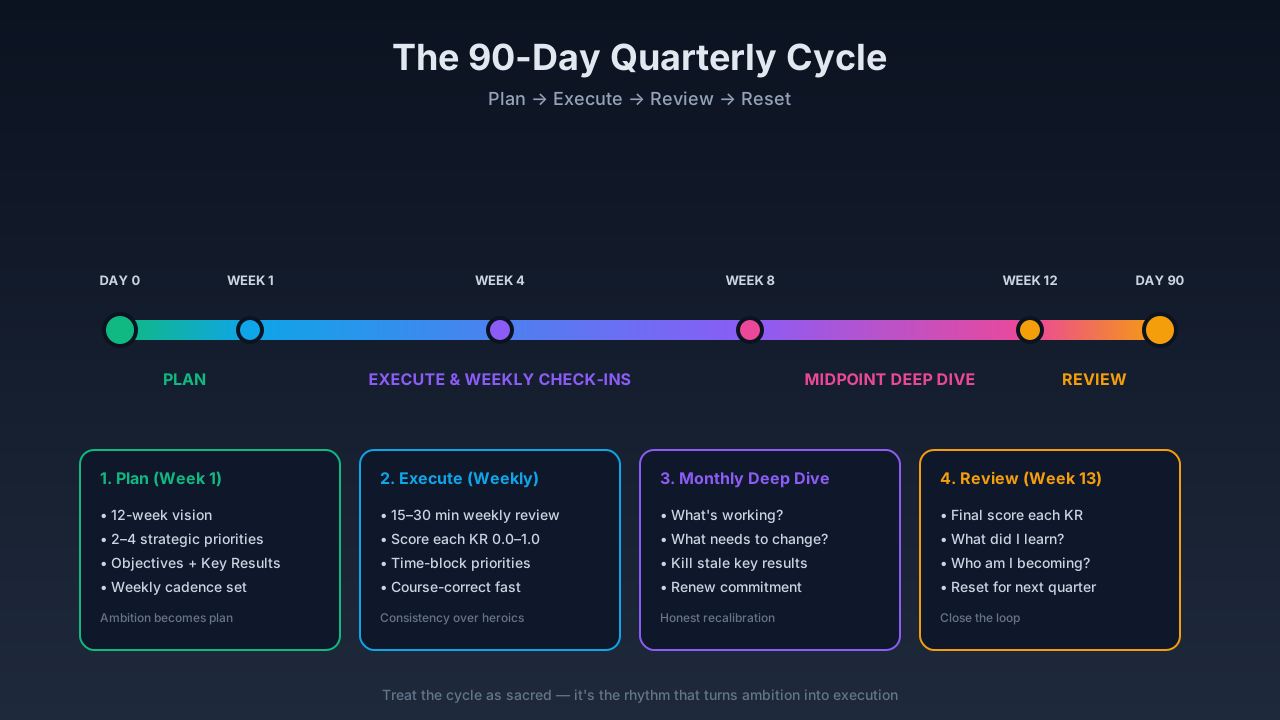
Quarterly OKRs: The Framework for 90-Day Execution
If you want to add structure to your quarterly goal setting, quarterly OKRs (Objectives and Key Results) are the sharpest tool available.
The OKR planning process for a quarter looks like this:
Identify 2-4 strategic priorities. Before writing any OKRs, decide what must change this quarter. Without clear priorities, OKRs become task lists disguised as goals.
Write objectives around outcomes, not activity. Your objective should describe the change you want to see, not the work you plan to do. "Improve customer onboarding experience" is an outcome. "Launch new onboarding flow" is activity.
Define measurable key results. Each objective gets 2-4 key results with specific numbers and deadlines:
- O: Improve my physical health this quarter
- KR1: Complete 48 workout sessions (4x/week for 12 weeks)
- KR2: Reduce body fat from 22% to 18%
- KR3: Sleep 7+ hours on 80% of nights
Limit to 3 objectives maximum. Overloaded quarterly OKRs dilute focus. One objective equals one meaningful outcome.
Plan reviews upfront. Decide before the quarter starts how often you'll review progress. Weekly or bi-weekly check-ins are non-negotiable.
Track Lead Measures, Not Lag Measures
One of the most powerful concepts from the 12 Week Year: the distinction between what you control and what you hope for.
Lead measures are the actions you control: minutes writing, drafts completed, workouts done, outreach emails sent.
Lag measures are the outcomes: income, page views, weight, followers.
Most people only track lag measures. Then they get frustrated when the scale doesn't move despite their "effort." Sound familiar?
Focus on lead measures. Keep a one-page scorecard. Aim for 85-100% weekly completion on your lead actions. If you drop below 70% for two weeks straight, reduce scope until you regain consistency. It's better to execute 85% of a smaller plan than 40% of an ambitious one.
Weekly Accountability: The 15-Minute Habit That Changes Everything
Every week, spend 15-30 minutes answering four questions:
- Score: What percentage of lead actions did I complete?
- Diagnosis: What worked? What didn't? Where did I hide in "busy work"?
- Decision: What will I adjust — schedule, scope, or approach?
- Commitment: What are my MITs and time blocks for next week?
This closed-loop accountability is what transforms quarterly planning from a wish list into an execution system. When you know you'll face yourself every Friday, you show up differently on Monday.
You can do this solo or with a partner. Both work. The key is consistency, not format.
Week 13: Four Fresh Starts Per Year
At the end of each 12-week cycle, review your scorecard and results. Celebrate what worked. Analyze what didn't. And then — this is the magic — reset with fresh energy.
Instead of carrying guilt for twelve months because you "failed" your annual goals, you get four chances per year to recalibrate. Your first Week 13 feels like a clean slate. You're not weighed down by what you haven't done — you're energized by what you've learned.
This is the mindset shift that makes quarterly goal setting sustainable. Perfection isn't the point. Direction and momentum are.
Common Quarterly Planning Pitfalls
Setting too many goals. Two to four priorities per quarter. More than that dilutes focus and creates confusion about what actually matters.
Tracking only lag measures. You'll feel frustrated when outcomes don't budge despite your efforts. Track the inputs you control.
Skipping weekly planning. Without weekly MITs and time blocks, quarterly goals drift. Each week is a small chapter in your 90-day story — skip it and the narrative falls apart.
Ignoring the quarterly review. Whether it's a formal review process or an honest journal session, skip this and you skip the engine that drives growth between quarters.
Chasing perfection. You miss a few days, fall behind, and your brain whispers "you've already blown it." The antidote: Did you make meaningful progress? Did you show up more consistently than last quarter? Did you learn something? That's success.
Your 90-Day Plan Starts Now
Here's your move. Block 60 minutes this week. Run the quarterly review — all seven steps. Set one to three quarterly OKRs with measurable key results. Schedule your first weekly accountability check-in.
That's the entire system. Vision, goals, weekly execution, quarterly reset. It's the 12 Week Year applied to your life.
And if you want a tool that was built specifically for this rhythm — IdealWeek connects your long-term vision to quarterly OKRs to weekly execution in one system. The OKR Engine handles your quarterly cycles with weighted Key Results and behind-the-plan alerts. The Execution Planner turns OKRs into daily time blocks. The Insights dashboard tracks your lead measures automatically and shows whether you're ahead or behind at a glance.
Stop planning in years. Start executing in quarters.
The Takeaway: Quarterly goal setting works because 90 days is the sweet spot — long enough for real progress, short enough to feel urgent. The system: run a quarterly review to set direction, write quarterly OKRs with measurable key results, track lead measures weekly, and use Week 13 as a reset. Four fresh starts per year beats one guilty December every time.
Related Articles
View all →
Best AI Goal Setting Apps in 2026: The Honest, Data-Backed Ranking
"Launch a side business by year-end."

The FACTS Framework: Five Superpowers That Make OKRs Work
Most ambitious people don't lack goals. They have plenty — a business that generates real income, a body they're proud of, a career they des…

How to Build a Personal Operating System from Scratch in 2026
Most people run their life on three things: adrenaline, memory, and willpower. Three of the most fragile systems ever invented.