The Difference Between Productivity and Progress (And Why One Is Lying to You)


The Difference Between Productivity and Progress (And Why One Is Lying to You)
Nathan Barry wrote three books in nine months. Not by sprinting. Not by locking himself in a cabin with seven energy drinks. He wrote exactly 1,000 words a day — for 253 days straight. That's it.
Meanwhile, a thousand other aspiring authors were out there "grinding," clocking 10-hour writing binges on weekends, then vanishing for a month. They had the higher maximum speed. They lost anyway.
The difference wasn't effort. It was the gap between being productive and making progress. And if you've ever ended a week exhausted but somehow nowhere closer to anything that matters — this article is about the exact mistake you're making.
Here's What Actually Happens
Productivity is a measure of efficiency. Progress is a measure of direction.
James Clear puts it bluntly: "Productivity is getting important things done consistently." Not busy. Not a lot. Important. Consistently. Every word in that sentence does work.
Here's the problem. Most of the productivity advice online — the morning routines, the inbox-zero tricks, the 4am cold plunges — optimizes for efficiency on its own. How much you can cram into a day. How fast you can reply to Slack. How many tasks you can check off before dinner.
None of that measures whether you're moving. That's the trap.
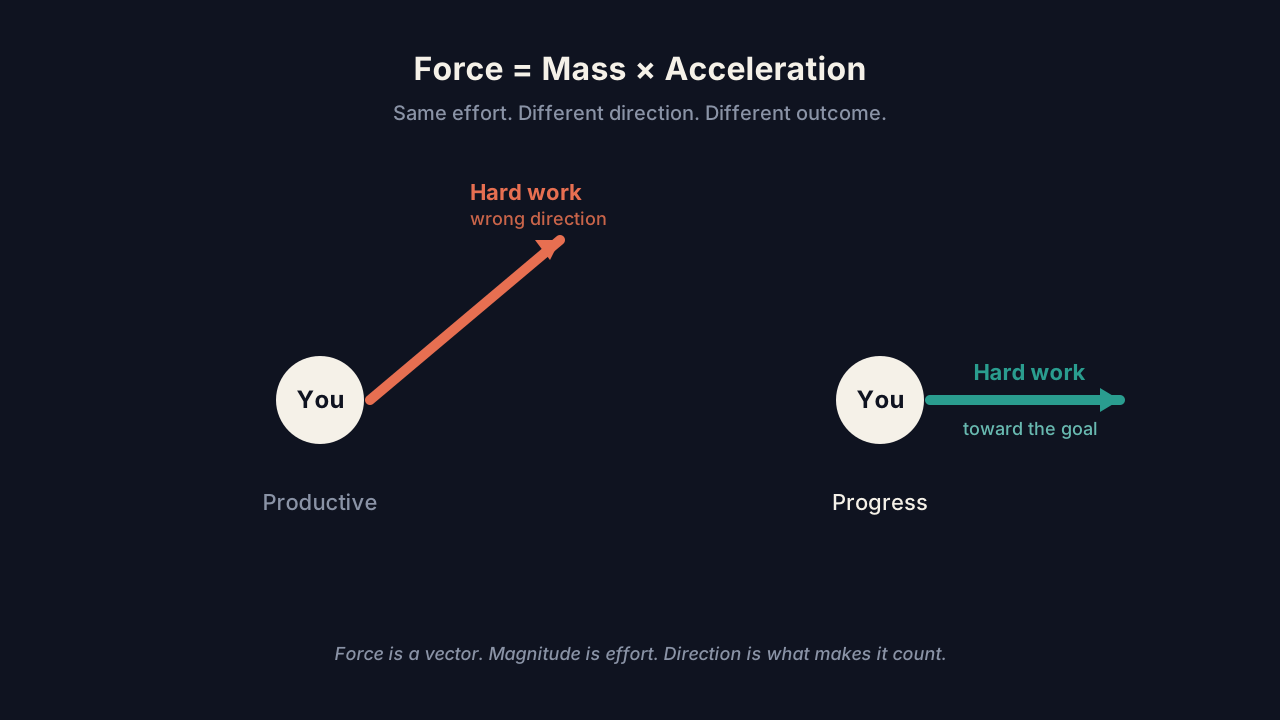
Newton's second law of motion is actually the cleanest explanation of why. Force = mass × acceleration. But force is a vector — it has magnitude and direction. As Clear writes:
"You only have a certain amount of force to provide to your work and where you place that force is just as important as how hard you work."
You can shove a boulder with everything you've got. If you're pushing north when your goal is east, you're not making progress. You're sweating.
You're Probably Doing This Right Now
Be honest for a second. Think about your last Sunday night.
You reviewed your week. You knocked out a stack of tasks. Emails, errands, small admin stuff. Some of it even felt good — that dopamine hit of a fresh to-do list, fully crossed out.
Now answer this: Which of those tasks moved you closer to the thing you actually said was important this year? The business. The fitness goal. The relationship you said you'd invest in. The book you've been "about to start" since January.
If the honest answer is "not many" — you were productive. You just weren't making progress. And this is where most people live their entire lives.
The research on why is ruthless. Edwin Locke and Gary Latham spent 30+ years studying what separates people who achieve from people who stay busy. Their conclusion:
"Difficult specific goals lead to significantly higher performance than easy goals, no goals, or even the setting of an abstract goal such as urging people to do their best."
Notice what's missing from that list: a full to-do list. A full to-do list without a specific, difficult goal anchoring it isn't progress — it's a highly efficient way of going in circles.
The Identity Shift Nobody Tells You About
Here's the part that'll sting a little.
Clear argues most people set goals at the wrong level entirely. There are three layers of change: outcomes (what you get), processes (what you do), and identity (what you believe).
"Outcomes are about what you get. Processes are about what you do. Identity is about what you believe."
Productivity lives at the outcome layer. "I want to lose 20 pounds." "I want to make six figures." "I want to launch the side project." You set the goal, you chase the metric, you optimize the process — and you wonder why you quit in week three.
The people who make real progress work the other direction. They ask: Who do I need to become to make this inevitable? Not "I want to write a book." Instead: I'm the type of person who writes 1,000 words a day, no matter what. Not "I want to get fit." Instead: I'm the type of person who never misses two workouts in a row.
Clear again:
"If you're looking to make a change, stop worrying about results and start worrying about your identity."
That's not a mindset quote. That's a strategy. Outcome-based goals collapse when motivation dips. Identity-based habits survive because they're about who you are, not what you're chasing.
Why OKRs Exist (And Why Your To-Do List Doesn't Cut It)
Here's where the math gets clean. The OKR framework — developed by Andy Grove at Intel in the 1970s, scaled at Google by John Doerr — was built specifically to solve the productivity-without-progress problem.
An OKR has two parts: an Objective (a significant, concrete, inspirational goal) and 3–5 Key Results (measurable success criteria). The rule, in Grove's words:
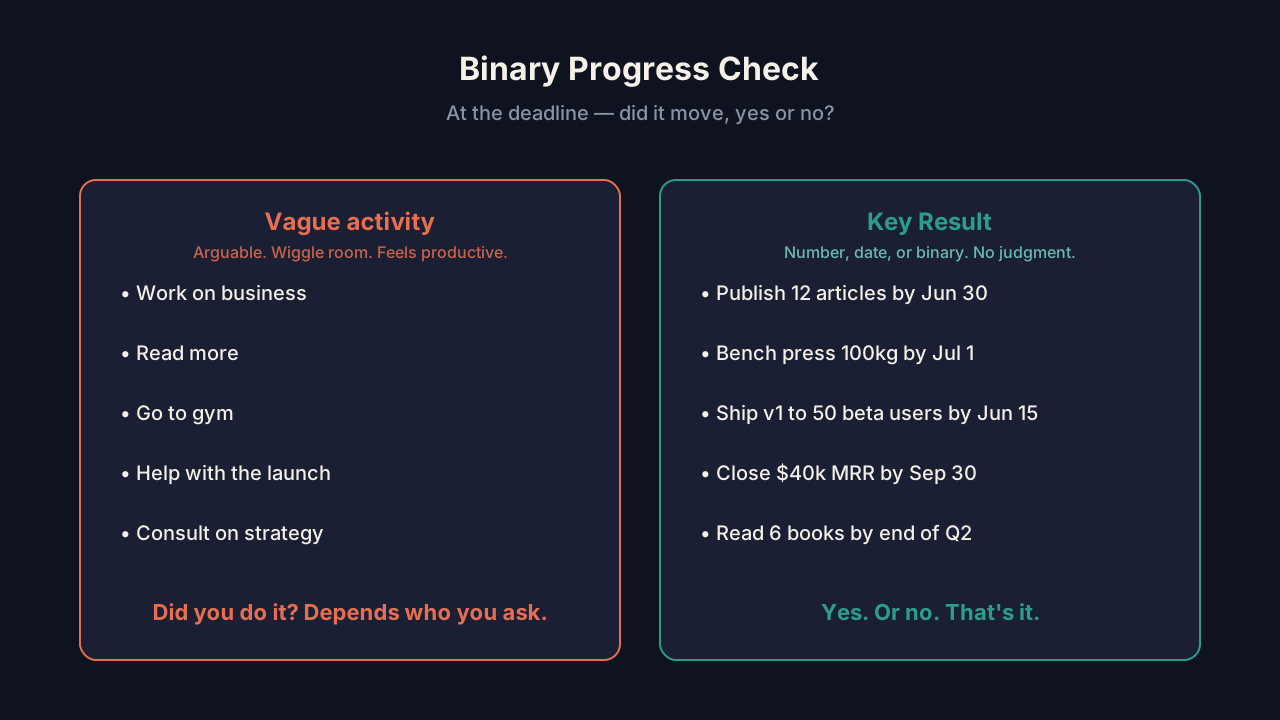
"The key result has to be measurable. But at the end you can look, and without any arguments: Did I do that or did I not do it? Yes? No? Simple. No judgments in it."
No grey area. No "I kind of worked on it." No "I made good progress, but..." Binary. Did it move or did it not?
And Doerr is explicit about what disqualifies a key result:
"Words like 'help' and 'consult' should be avoided as they tend to describe vague activities rather than concrete, measurable outcomes."
Read that again. Vague activities. That's a clinical term for most people's to-do lists. "Work on business." "Read more." "Go to gym." All productive-sounding. None measurable. None of them a progress signal.
Compare that to:
- Publish 12 articles by end of Q2.
- Bench press 100kg by July 1.
- Ship v1 of the app to 50 beta users before June 15.
Those are key results. They're binary. At the deadline, you know — with zero emotional spin — whether you made progress or not.
The Stupid-Simple Fix
So what do you do tomorrow morning? Not some 90-day manifesto. Three moves, in order.
1. Kill the outcome goal and define an identity. What's the version of you that makes the goal inevitable? Write it in one sentence. "I'm the type of person who _______." This is the north star.
2. Pick one objective and three measurable key results for the next 12 weeks. Not ten. Not five. One. Kill the rest. Each key result must be a number, a date, or a binary yes/no. If you read it out loud and can argue about whether you hit it, it's not a key result.
3. Define your average speed, not your maximum speed. What can you do every single day — even on your worst day, after a red-eye flight, while sick — that proves the identity? 10 minutes of writing. 20 minutes of gym. One outreach message. That number is your floor. Do not negotiate with it.
And then — the hardest part — stop adding force and start removing friction. Clear's third law of productivity:
"If you want to be more productive, you can either power through the barriers or remove the opposing forces. The second option seems to be less stressful."
Most people try to out-hustle the problem. Another app. Another 5am alarm. Another motivational reel at midnight. The people actually making progress go the other way: they delete the distractions, say no more, simplify the environment, and let progress happen because nothing's fighting them anymore.
Zoom Out
Here's what compounds if you get this right.
In one year, you will not have worked 10× harder than everyone else. You will have worked on the right things, in the right direction, at a sustainable average speed, while the people around you burned out chasing maximum speed on the wrong targets.
"It doesn't require a massive effort to achieve incredible results — just a consistent one."
That's Nathan Barry's 253-day streak. That's every person who ever built anything that lasted. Productivity gets you a crossed-off list. Progress gets you a different life.
So close this tab. Open a fresh note on your phone. Write one identity sentence. Write one objective. Write three key results with numbers or dates. That took five minutes.
You just made more progress than most people will make all week.
Related Articles
View all →
Measure What Matters Book Summary: John Doerr's OKR Guide
When John Doerr walked into a conference room at Google in 1999, the company had fewer than 50 employees. Larry Page and Sergey Brin were br…

Measure What Matters: The OKR Framework That Transformed Google and Can Transform Your Life
You've got big dreams. Maybe it's building a business that matters. Maybe it's running a marathon. Maybe it's being present for your family…

Atomic Habits Summary: Key Lessons from James Clear
You set a goal to work out three times a week. You lasted two weeks. You decided to read 30 minutes before bed. That lasted until your phone…