Focus Mode Apps With AI in 2026: How Smart Distraction Blocking Actually Works


Focus Mode Apps With AI in 2026: How Smart Distraction Blocking Actually Works
You sit down at 9:00 to write the thing. You glance at your phone at 9:04. Three reels later, it's 9:22 and you don't remember deciding to open Instagram. It just... happened.
The part that should scare you isn't the 18 minutes you lost. It's what comes next. It has been estimated that it can take up to 25 minutes to get back on track after you are distracted from the task at hand. That 30-second dopamine hit actually cost you 43 minutes of real cognitive work. Do that three times before lunch and your "8-hour workday" is really a 4-hour one with a parade of interruptions you didn't schedule.
The anti-distraction industry knows this. It's worth $7 trillion in the US alone. And for most of its history, it's been selling you the same dumb product — a list of websites you promise to block, which you bypass in 4 seconds when the urge hits. The new wave of focus mode apps with AI is genuinely different. Here's how they actually work.
Here's What Actually Happens Inside These Apps
Traditional blockers run on a binary: this URL is allowed, this URL is not. It's 2009 thinking. The problem? Real work doesn't split cleanly.
Zach Yang, the creator of Fomi, ran into this the hard way:
"He needed YouTube for study videos, so web/app blockers didn't work... That's when I started thinking about using AI to solve this."
So instead of a blocklist, Fomi watches your screen. You tell it what you're working on — writing a research paper, editing a client deck, studying for the MCAT. It checks periodically, and:
"The tool can tell, from context, whether you're using a particular website productively or as a distraction."
YouTube for a coding tutorial → green dot, you're good. YouTube for "funny cat Vine compilation 2013" → the dot turns yellow, then red, and an animated tomato splats across your screen. Same app. Same URL pattern. Completely different decision.
That's the core shift. AI focus tools stopped asking where you're browsing and started asking why.
The Apps Don't Just Block. They Learn.
Opal doesn't make you configure rules. It just watches what you open when you're procrastinating.
"After a few weeks, it'll ask if you want to restrict it during similar time windows automatically. You didn't have to set that rule. The app figured it out."
Think about what that means. You didn't set up a Tuesday-at-3pm-block-TikTok rule. The app noticed that every Tuesday at 3pm your productivity tanks because you're 40 minutes deep in TikTok. It builds the rule for you. On-device, by the way — Opal processes most of that behavioral data locally for privacy.
Camera-Based Gaze Tracking Is a Thing Now
Focusly uses your phone's front camera to track where your eyes are actually looking. If your gaze drifts off screen for several seconds, it pings you back. Sounds invasive? It's not storing video:
"Focusly is upfront about the fact that no video is recorded or stored. It only processes the feed in real time, locally."
This is the 2026 version of tapping your shoulder when you space out. And honestly — it works. Most of your "distractions" aren't opening another app. They're your brain checking out while your eyes still face the screen.
Gamification Does More Than You'd Guess
The #1 focus app on Google Play in 2025 wasn't a heavy-duty enterprise tool. It was Focus Friend — a cartoon bean that knits socks while you work.
"Focus Friend... was named Google Play's best app of 2025."
Seriously. A knitting bean. Why did it win? Because focus isn't a willpower problem — it's an emotional problem. A progress bar doesn't move you. A little guy who will be sad if you stop working? That does.
Fomi uses the same principle with its dot system: green (focused), yellow (drifting), red (that tomato splat). You're not reading a dashboard. You're getting a reaction.
You're Probably Doing This Right Now
Be honest with yourself for a second. You probably have one of these patterns:
- The 4-second bypass. You set up a website blocker. You hit a block page. You click "disable for 5 minutes" without even thinking. You're back on the exact site the blocker was supposed to save you from.
- The list you forgot to update. You blocked Twitter last year. You don't use Twitter anymore. You use TikTok, Instagram Reels, and YouTube Shorts. Your blocker is fighting the last war.
- The uninstall in the heat of the moment. You get blocked. You uninstall the blocker. You reinstall it Sunday night with grand resolutions. Repeat weekly.
FocusMe was built for that last category. Their "Four Layers of Plan Protection" get progressively ridiculous:
- Reboot and uninstall protection (can't kill the app to bypass it).
- Random password generator up to 2,000 characters long. You're not memorizing that.
- Custom password handed to a trusted friend, who can release it.
- Forced focus mode with no pause button. You finish the session or you finish the session.
It's overkill. That's the point. 100,000+ downloads, 10 years of development — people want the overkill because the soft version never worked.
Meanwhile, one sec goes the opposite direction. No blocking. Just friction. You tap Instagram, and it shows you a breathing animation and a counter: you've opened this app 47 times today. That's it. The result?
Cut mindless Instagram opens by about 70%.
Because 70% of your app opens are pure reflex. Break the reflex, you break the pattern. No password, no fight. Just a two-second pause long enough for your prefrontal cortex to wake up and ask "do I actually want to do this?"
The Privacy Trade-Off Nobody Talks About
Here's where it gets uncomfortable. If an AI is reading your screen to decide what's work vs. distraction, that data has to go somewhere.
Fomi's honest about it: the app uploads around half a gigabyte of screenshot data during a regular workday. Half a gig. Of screenshots. Daily. To a cloud AI model. They do run a local pass to strip out personally identifiable information first:
"Before anything leaves your machine, we run a local computer-vision pass to detect and redact personally identifiable information." — Zach Yang
Okay. But the volume is still wild. And that's one app. Multiply by every "AI-powered" tool you're tempted to install — scheduling, writing, focus, journaling — and your screen is being photographed and shipped to five different data centers around the clock.
The tension is real. Local-only AI (Focusly, on-device Opal processing) is privacy-safer but less capable. Cloud AI (Fomi) is smarter but sees everything. There's no free lunch here, and any app that tells you otherwise is lying to you.
Proactive vs. Reactive: Two Philosophies
Every focus app in 2026 falls into one of two camps.
Reactive — Flow, Focusly, Fomi, Focus Friend. They assume you'll get distracted and intervene when you do. Tomato splats. Gentle shoulder taps. Knitting beans pausing their work.
Proactive — Motion, Reclaim AI. They analyze your historical productivity data and restructure your calendar so distraction is less likely in the first place. Deep work blocks scheduled at 10am because you're measurably sharper then. Meetings batched so your afternoon has two uninterrupted hours.
"Rather than stopping you mid-scroll, it tries to put you in situations where distraction is less likely in the first place."
Both work. They work better together. Reactive catches you when your structure breaks. Proactive means your structure breaks less often.
The Stupid-Simple Fix
Look — you don't need five AI focus apps. You need a system that does three things at once.
- A scheduled focus block tied to a real goal, not a vague "deep work session" that becomes lunch. Thirty minutes or ninety, on your calendar, with a specific deliverable.
- A friction layer on your top 2–3 distractions. Not a full blocker. Just a pause. one sec-style. Enough to wake up the part of your brain that decides.
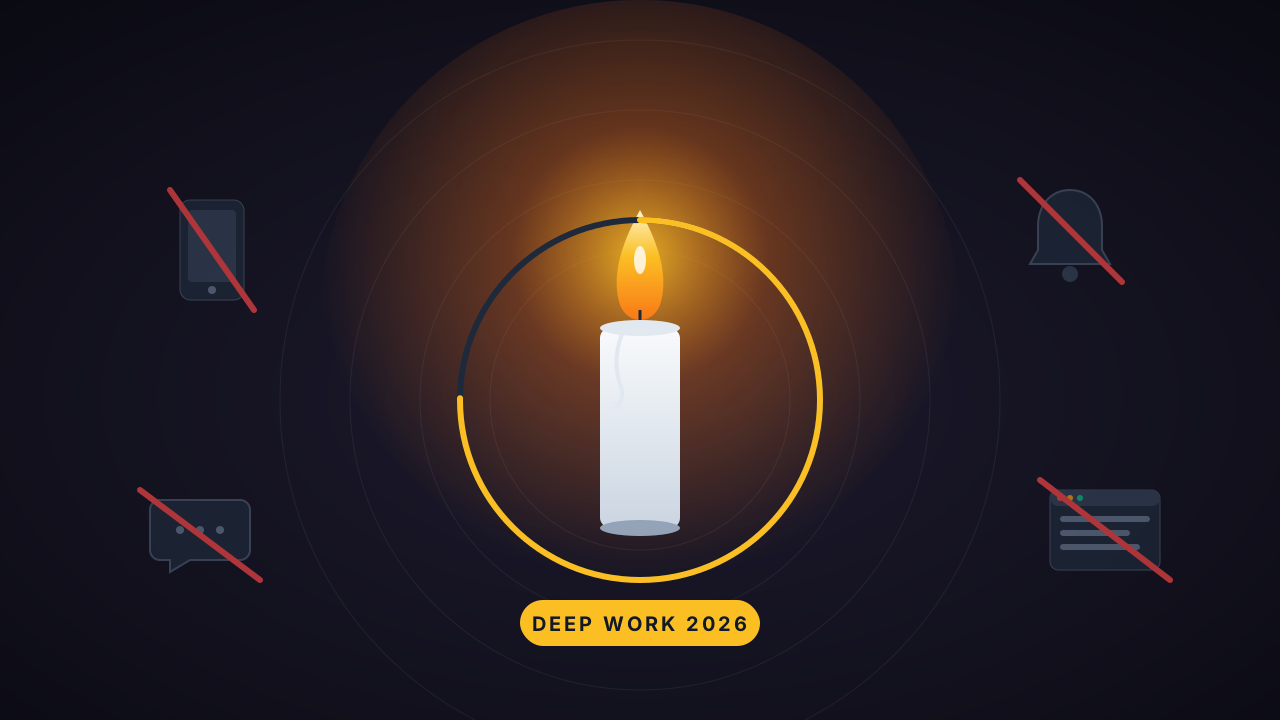
- Visible accountability while you work. A tomato. A bean. A burning candle. Something that notices when you drift and makes you feel it.
That's the whole playbook. Every app in this article is some combination of those three. Pick the ones that fit your brain and stop stacking tools.
Zoom Out
The $7 trillion distraction economy isn't an accident. Attention is being engineered away from you by teams of very smart people with every data point about your behavior. Your raw willpower vs. their algorithm is not a fair fight. It never was.
Focus mode apps with AI aren't a magic fix. They're counter-engineering. They move your attention problem from "try harder" to "design smarter." The person who ships in 2026 isn't the one with more discipline. It's the one who stopped fighting the algorithms with grit and started using structure that makes the good choice the default.
Open your calendar right now. Block one 60-minute window tomorrow morning labeled with an actual outcome — "draft section 3 of the proposal", not "work". Install one friction app on your two worst offenders. Do not install five tools. Do not research for an hour. Do one block tomorrow. That's the start of the system that will still be running in December.
Related Articles
View all →
Best AI Focus and Distraction Blocking Apps in 2026 (Tested, Ranked, Honest)
It's 3:17 PM. You were deep into a task at 2:45. You glance at your phone for "one second." Instagram. A reel. Another reel. A DM. A text. B…
Best Apps for Deep Work and Focus in 2026: Distraction Blockers, Flow State Tools, and More
You don't have a focus problem. You have an environment problem.

How to Stop Being Busy and Start Being Productive (The Honest Playbook)
It's 5:12pm. You're exhausted. You had back-to-back meetings, cleared 47 emails, hopped between four projects, said yes three times you shou…