How to Use the Pomodoro Technique With AI Tools in 2026

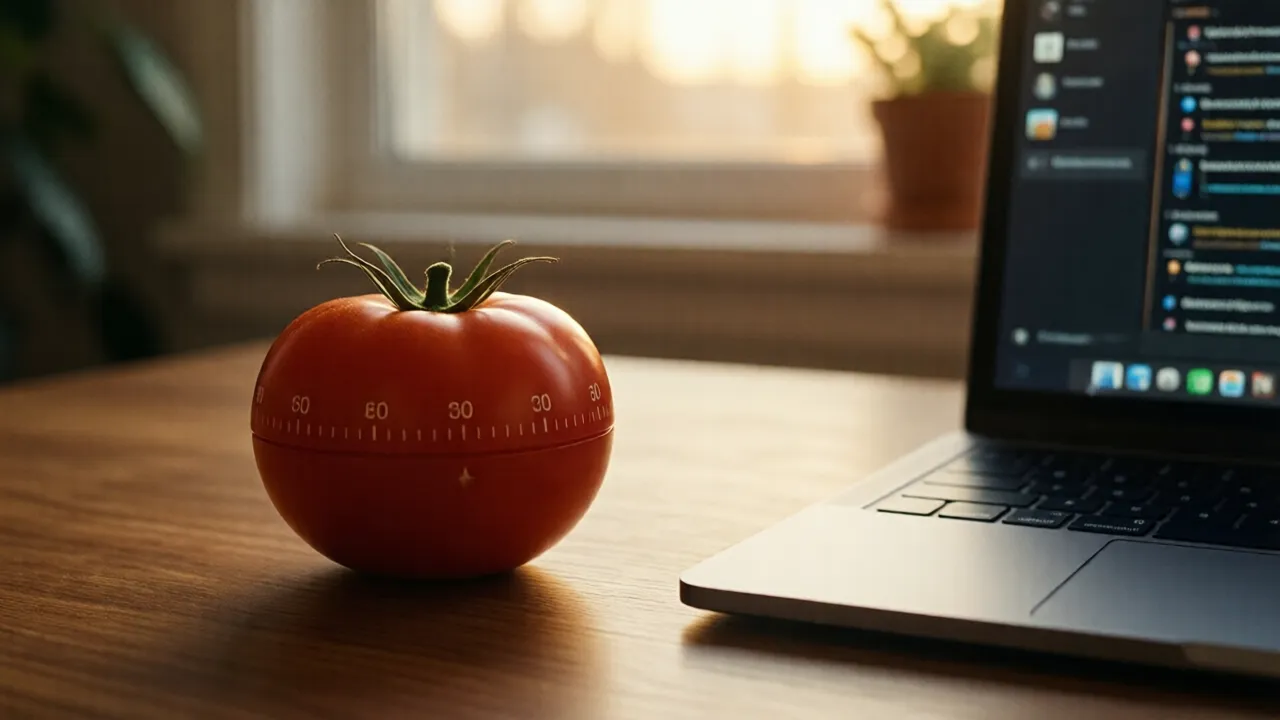
How to Use the Pomodoro Technique With AI Tools in 2026
You sit down to work on the thing that actually matters. You set a 25-minute timer. Three minutes in, a thought hits you: is 25 the right number? Should I be doing something else first? When should I come back after the break?
You just burned your first Pomodoro on meta-questions.
Here's what most advice misses. The Pomodoro technique isn't about the timer — it's about not having to decide. Francesco Cirillo's 1980s method works because it takes a bunch of tiny mental negotiations off your plate. And in 2026, AI tools are quietly fixing the one part Cirillo never solved: what to do when the default 25/5 isn't the right rhythm for your brain, this task, today.
Let's break down how the AI-Pomodoro combo actually works — and when it genuinely helps vs. when it's just another app between you and the work.
Here's What Actually Happens In Your Brain
The 25-minute Pomodoro wasn't random. Cirillo built it on kitchen-timer intuition, but the neuroscience caught up later:
"The brain maintains optimal focus for approximately 20–45 minutes before experiencing cognitive fatigue."
Past 45 minutes of hard cognitive work, your prefrontal cortex is running on fumes. You think you're still focused. You're actually executing on autopilot, making 40% more errors, and spending the last 20 minutes fighting intrusive thoughts about lunch.
A 2025 meta-analysis put it plainly:
"Time-structured Pomodoro interventions consistently improved focus, reduced mental fatigue, and enhanced sustained task performance, outperforming self-paced breaks."
Translation: people who take scheduled breaks outperform people who "break when they feel like it." Because by the time you feel like breaking, you've already been underperforming for 15 minutes. The timer protects you from your own judgment at your worst moment.
The Zeigarnik Effect Is Why You Can't Start
Ever notice how starting a task feels impossibly hard, but once you're in it, it's fine? That's the Zeigarnik Effect:
"The brain remembers unfinished tasks more vividly than completed ones, creating psychological resistance to starting."
Pomodoro hacks this perfectly. Your brain isn't committing to "finish the whole report." It's committing to "work for 25 minutes." That's a radically smaller activation energy. You can always convince yourself to try 25 minutes. You can rarely convince yourself to write 8 pages.
Why Decision Fatigue Kills Your Day
"Daily micro-decisions deplete mental energy reserves; pre-scheduling preserves cognitive bandwidth."
Every time you ask "what should I do next?" you pay a tax. Stack 40 of those decisions across a day and you're mentally exhausted by 3pm with nothing to show for it. Pomodoro removes most of those decisions. Work block → break block → repeat. No negotiation.
This is the part AI is now amplifying, not replacing.
You're Probably Doing This Right Now
Be honest with yourself — one of these is you:
- You use a Pomodoro app, but you restart the session every time you get interrupted, so you never actually finish one.
- You set 25 minutes for every task, even the ones that clearly need 90 minutes of unbroken flow.
- You take the 5-minute break by opening Instagram, which rockets you into 25 minutes of scrolling. Break turns into abandonment.
- You burn the first Pomodoro figuring out which Pomodoro to do. The session becomes meta-work.
- You've got six Pomodoro apps installed. None of them sync with your calendar. You're re-entering your to-do list three times a day.
Each of these is a decision problem, not a willpower problem. Which is exactly what AI is good at fixing.
How AI Actually Changes the Technique
Let's get specific. Here's what AI-powered Pomodoro tools do that the old kitchen timer can't.
1. Adaptive Intervals Instead of Rigid 25/5
Tools like ClickUp's AI Pomodoro generator don't assume 25 minutes is right:
"AI assesses task complexity, focus patterns, and break frequency to propose personalized work and rest periods tailored for maximum efficiency."
Admin work? Maybe 15/3 — short bursts to lower the barrier to starting. Creative deep work? 52/17 is actually the empirically supported rhythm for extended flow states:
"Creative/Deep Work: Extend to 45–50 minutes for deeper immersion."
The point isn't that 25 is wrong. It's that one size is wrong. AI watches what actually works for you and stops asking you to guess.
2. AI-Picked Next Task
The hardest part of a Pomodoro session is the 30 seconds before it starts — which task first? AI tools now do this for you:
"AI analyzes to-do lists, deadlines, and historical productivity data to recommend the optimal tasks for each upcoming work session."
Your timer rings. The next task is already queued. You don't open five apps to figure out what to work on. You just start. That's the entire win — no meta-work between sessions.
3. Real-Time Adjustment Mid-Session
"Dynamically adjusts to task urgency and complexity to prevent fatigue during high-pressure periods."
Slammed week with three deadlines? AI can shorten focus blocks and insert longer recovery windows to prevent the burnout spiral. Slower week? Extend blocks to catch flow state. Cirillo's timer is a ruler; AI turns it into a thermostat.
4. Actually Useful Breaks
Your "break" shouldn't be the thing that destroys your next session. Most of them are. AI tools suggest recovery activities matched to what your body and brain actually need:
"Suggests personalized rejuvenation activities during downtime, such as stretching routines, meditation, or mood-boosting content."
Stare at a wall. Stretch. Hydrate. Three slow breaths. Not Instagram. A well-structured break is mostly about your nervous system resetting — and AI prompts are good nudges to actually do the non-obvious stuff.
The Stupid-Simple Fix
Don't stack six tools. Here's the minimum viable AI-Pomodoro setup for tomorrow morning:
- Pick one tool that integrates with your calendar and task list. Pomodoro tools work best when they don't live alone:
"Pomodoro timers should integrate seamlessly with existing productivity stacks rather than replace them."
- Let AI set the interval for the task type. Quick admin → 15/3. Writing → 25/5. Deep build/creative → 50/15. Don't fight the tool's recommendation unless you've tested otherwise.
- Queue tomorrow's top 3 tasks tonight. AI can prioritize. You give it the list — your future self doesn't need to pick in the morning.
- Phone in another room during work blocks. No app can outplay a phone in your pocket. This is your part of the deal.
- Honor the break. If the tool says "stretch," stretch. If it says "walk 90 seconds," walk. Breaks aren't optional — they're the reason the method works.
- Keep one Pomodoro cycle tied to your top OKR. Don't let the method become productivity theater for small tasks. At least one session per day on the thing that actually moves your life forward.
Zoom Out
The Pomodoro Technique survived 40 years because it solved a real problem: humans are bad at regulating their own focus across a workday. AI doesn't change the problem. It makes the solution cheaper to run.
The trap is letting the tools become the work. If you spend more time configuring your AI Pomodoro setup than doing Pomodoros, you've missed the point. The method is deliberately boring — set timer, work, break, repeat. AI should make it more boring, not more interesting. The interesting part is what you produce in those 25 minutes.
Open your timer right now. Pick the 25 minutes after you finish reading this. Pick one task that would make tomorrow-you proud you started. Don't research a better tool. Don't optimize your setup. Start the timer, work until it rings, take the break, do one more. A year from now you'll either have built something real, or you'll have the best Pomodoro app stack on earth and nothing to show for it.
Related Articles
View all →
Best AI Focus and Distraction Blocking Apps in 2026 (Tested, Ranked, Honest)
It's 3:17 PM. You were deep into a task at 2:45. You glance at your phone for "one second." Instagram. A reel. Another reel. A DM. A text. B…
Best Apps for Deep Work and Focus in 2026: Distraction Blockers, Flow State Tools, and More
You don't have a focus problem. You have an environment problem.

Focus Mode Apps With AI in 2026: How Smart Distraction Blocking Actually Works
You sit down at 9:00 to write the thing. You glance at your phone at 9:04. Three reels later, it's 9:22 and you don't remember deciding to o…