Time Management Strategies That Actually Work in 2026


Time Management Strategies That Actually Work in 2026
Here's an uncomfortable truth: you probably waste 3–4 hours every workday. Not on purpose. Not because you're lazy. But because nobody taught you how time actually works.
Research from RescueTime shows the average knowledge worker is productive for about 2 hours and 48 minutes in an 8-hour day. The rest? Meetings that could be emails. Emails that could be ignored. Social media checks disguised as "quick breaks." And the constant mental tax of switching between tasks — which, according to the American Psychological Association, costs you up to 40% of your productive capacity.
The time management strategies that actually work in 2026 aren't about squeezing more tasks into your day. They're about aligning your energy, attention, and actions with the things that genuinely matter. Here are the ones backed by real evidence.
Time Blocking: Turn Priorities Into Commitments
Time blocking is the simplest strategy on this list, and probably the most effective. You take your priorities, assign them specific blocks of time on your calendar, and treat those blocks like meetings with yourself.
No more "I'll get to it when I have time." You never have time. You make it.
Cal Newport — the computer science professor who literally wrote the book on deep work — time blocks every single day. His argument: "A 40-hour time-blocked work week produces the same amount of output as a 60+ hour work week pursued without structure."
How to actually do it:
- At the start of each day (or the night before), list your 3 most important tasks
- Assign each one a specific time block — with a start time and end time
- Protect those blocks like you'd protect a meeting with your boss
- Batch smaller tasks (emails, messages, admin) into dedicated blocks instead of letting them interrupt deep work
The key insight: time blocking doesn't just organize your day — it pre-decides what you'll do so you don't waste mental energy choosing in the moment. Every decision you eliminate is energy saved for the actual work.
Eat the Frog: Do the Hard Thing First
Mark Twain (allegedly) said: "If the first thing you do each morning is eat a live frog, you can go through the day with the satisfaction of knowing that is probably the worst thing that is going to happen to you all day long."
Your "frog" is the task you're most likely to procrastinate on. The one that makes your stomach clench slightly when you think about it. The report. The difficult conversation. The strategic planning you keep pushing to "next week."
Do it first.
Not because morning is magically productive (though for most people, it is — research on circadian rhythms confirms cognitive performance peaks 2–4 hours after waking). But because willpower is a depletable resource. The decisions, distractions, and micro-stresses of the day chip away at your ability to tackle hard things. By 3pm, that frog looks impossibly large.
By 10am? It's just a frog. Eat it.
The Eisenhower Matrix: Stop Confusing Urgent with Important
President Eisenhower said: "I have two kinds of problems, the urgent and the important. The urgent are not important, and the important are never urgent."
Most people spend their days in a reactive state — constantly responding to whatever feels most urgent. But urgent and important are completely different things:
- Urgent + Important → Do it now (deadline crisis, critical client issue)
- Important + Not Urgent → Schedule it (strategic planning, skill development, relationships)
- Urgent + Not Important → Delegate it (most emails, routine approvals)
- Not Urgent + Not Important → Delete it (mindless scrolling, unnecessary meetings)
Here's the trap: Quadrant 2 — Important but Not Urgent — is where all the life-changing work lives. Your long-term goals. Your health. Your skills. Your relationships. But because nothing is on fire, you keep pushing it off to handle the "urgent" stuff that ultimately doesn't matter.
The Eisenhower Matrix forces you to see this pattern. And once you see it, you can't unsee it.
Pro tip: Limit each quadrant to 10 items max. If your "urgent and important" list has 25 items, you haven't prioritized — you've just made a long list.
The 80/20 Rule: Find Your High-Impact 20%
The Pareto Principle says 80% of your results come from 20% of your efforts. Applied to time management, it's devastating — because it means roughly 80% of what you do every day barely moves the needle.
Think about your last week. Which activities produced actual, measurable progress? And which ones felt productive but didn't really change anything?
For most people, the high-impact 20% includes: deep work on key projects, strategic conversations, skill development, and health/recovery. The low-impact 80% includes: most meetings, email ping-pong, "researching" (scrolling), and tasks you do because they're comfortable, not because they matter.
How to find your 20%:
- Review your last 2 weeks and mark tasks that produced tangible outcomes
- Identify which activities directly moved your goals forward
- Build your week around protecting time for those activities
- Be ruthless about reducing everything else
Task Batching: Stop Context Switching
Every time you switch tasks, your brain pays a tax. Research shows it takes an average of 23 minutes and 15 seconds to fully recover focus after an interruption. If you switch tasks 10 times a day, that's nearly 4 hours of recovery time — just from switching.
Task batching is the antidote. Group similar tasks together and knock them out in one focused session:
- Communication batch: All emails, Slack messages, and replies in two 30-minute blocks per day
- Creative batch: All writing, designing, or strategic work in one uninterrupted block
- Admin batch: Scheduling, invoicing, filing — all in one session
- Meeting batch: Stack meetings back-to-back on specific days to protect the rest
The principle: every context switch costs you. Minimize switches, maximize depth.
The Pomodoro Technique: Use Urgency to Your Advantage
A 2025 scoping review in BMC Medical Education analyzed 32 studies and found 88% showed positive outcomes from the Pomodoro Technique. Focus improved 15–25%. Mental fatigue dropped ~20%.
The method: work for 25 minutes, break for 5, repeat. After four rounds, take a 15–30 minute break. The timer creates artificial urgency that prevents drift.
But the real power isn't the timer — it's the constraint. When you know you only have 25 minutes, you stop overthinking and start doing. The technique also eliminates multitasking by design: one task per Pomodoro, no exceptions.
Customize it: The 25/5 default is a starting point. Some people do better with 50/10 or even 90/20 for deep creative work. The principle — structured work-break cycles — matters more than the exact numbers.
Time Tracking Apps: The Strategy Most People Skip
Here's the time management strategy nobody wants to do: actually track where your time goes.
Not estimate. Not guess. Track.
Most people overestimate productive time by 30–50%. You think you worked 6 focused hours. The data says 2.5. You think the report took 45 minutes. It took 2 hours. This gap between perception and reality is why your plans always feel too ambitious — because they're built on inaccurate time estimates.
A time tracking app destroys that illusion. And that's exactly why it works.
What time tracking reveals:
- Which tasks actually take the longest (vs. what you assume)
- Where your biggest time leaks are (social media, email, meetings)
- Your peak productivity hours (when to schedule deep work)
- The real cost of interruptions and context switching
The best time tracking apps serve different needs:
- RescueTime — Automatic background tracking, zero effort, gives you weekly productivity reports
- Toggl — Manual timer-based tracking, great for freelancers who bill hourly
- Clockify — Free team time tracking with project categorization
IdealWeek's productivity analytics take this a step further. Instead of just tracking screen time, IdealWeek shows your 7-day time allocation breakdown — how much time went to OKR activities vs. ad-hoc tasks vs. routine work. Combined with behind-the-plan alerts that compare your actual progress to where you should be, it doesn't just tell you where time went — it tells you whether that time was spent on the things that actually matter.
The difference: generic time tracking tells you how long you worked. Productivity analytics connected to your goals tell you how effectively you worked.
Movement: The Productivity Strategy That Doesn't Feel Like One
This one's going to sound unrelated to time management. It's not.
Research consistently shows that physical activity improves focus, energy, mood, and cognitive function. A study in the British Journal of Sports Medicine found that even 20 minutes of moderate exercise improves concentration and mental processing for up to 2 hours afterward.
That means a 20-minute walk before your deep work block could be the single highest-ROI time investment of your day.
Simple ways to build movement into your schedule:
- Walk during phone calls
- Take a 10-minute movement break between time blocks
- Schedule exercise as a non-negotiable time block (not something you do "if there's time")
- Use a standing desk for routine tasks, sit for deep work
The paradox: spending 30 minutes on exercise gives you back more than 30 minutes in improved focus and energy. It's not time spent — it's time invested.
Stop Reading About Time Management. Start Managing Your Time.
You now have seven evidence-based strategies. You don't need all of them. You need two or three that match how you work, applied consistently for the next 30 days.
Here's your starting stack:
Week 1: Time block your top 3 priorities each morning. Eat the frog first. Week 2: Add task batching — group emails, meetings, and admin into dedicated blocks. Week 3: Start tracking your time. See where it actually goes. Adjust. Week 4: Add Pomodoro sessions for your deepest work. Protect those blocks ruthlessly.
That's it. Four weeks. Four adjustments. No app-shopping, no system-building, no productivity YouTube rabbit holes.
The best time management strategy is the one you actually use tomorrow morning. Not the one you bookmark and forget.
Tomorrow at 9am, block 90 minutes for your most important work. Set a timer. Turn off notifications. Close every tab except the one you need.
That's time management. Everything else is just reading about it.
Related Articles
View all →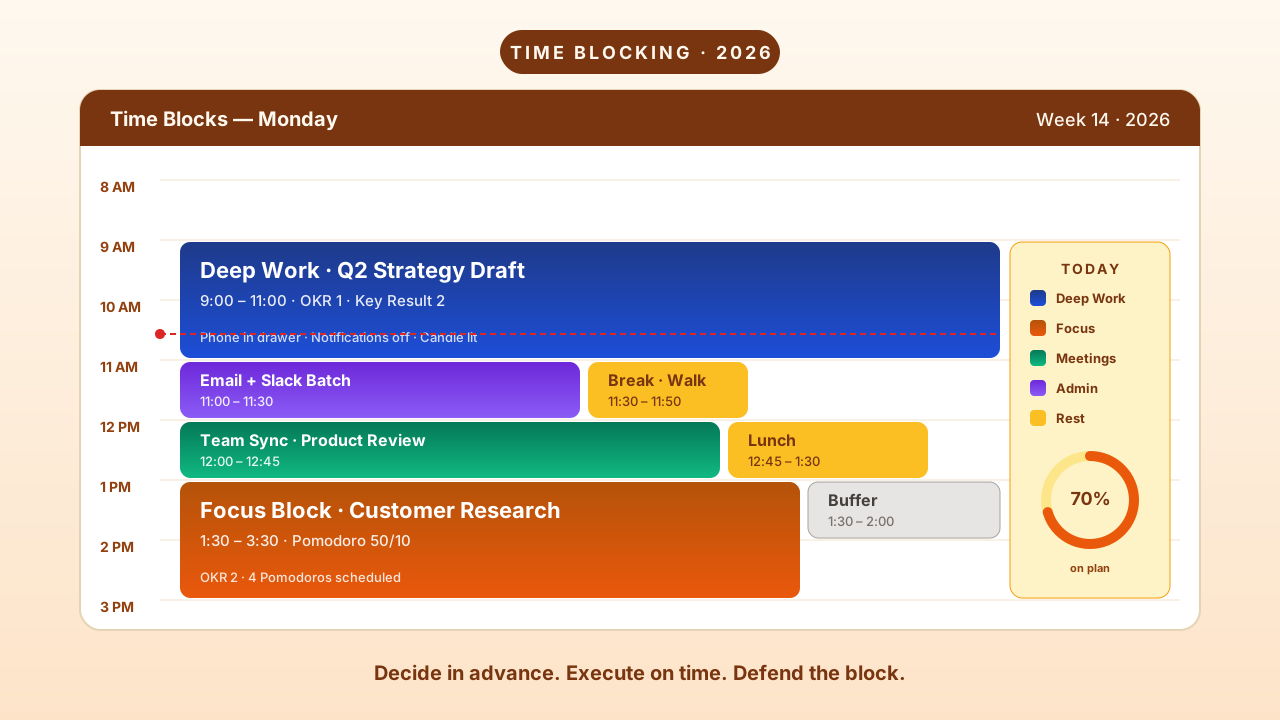
Time Blocking: The Complete Guide to Taking Control of Your Schedule in 2026
Right now, somewhere, you have a to-do list with 15+ items on it. You've been staring at it for 20 minutes trying to decide what to do first…

Best AI Focus and Distraction Blocking Apps in 2026 (Tested, Ranked, Honest)
It's 3:17 PM. You were deep into a task at 2:45. You glance at your phone for "one second." Instagram. A reel. Another reel. A DM. A text. B…
Best Apps for Deep Work and Focus in 2026: Distraction Blockers, Flow State Tools, and More
You don't have a focus problem. You have an environment problem.