The Best Vision Board App in 2026 — And Why Most Stop at the Picture

The Best Vision Board App in 2026 — And Why Most Stop at the Picture
In 2011, researchers Heather Kappes and Gabriele Oettingen ran an experiment that should worry anyone building a vision board this week. They found that positive fantasies about the future — imagined vividly, with no realistic look at the obstacles in the way — didn't just fail to help. They reduced effort and achievement. The vision board app on your phone right now might be doing the exact same thing to you.
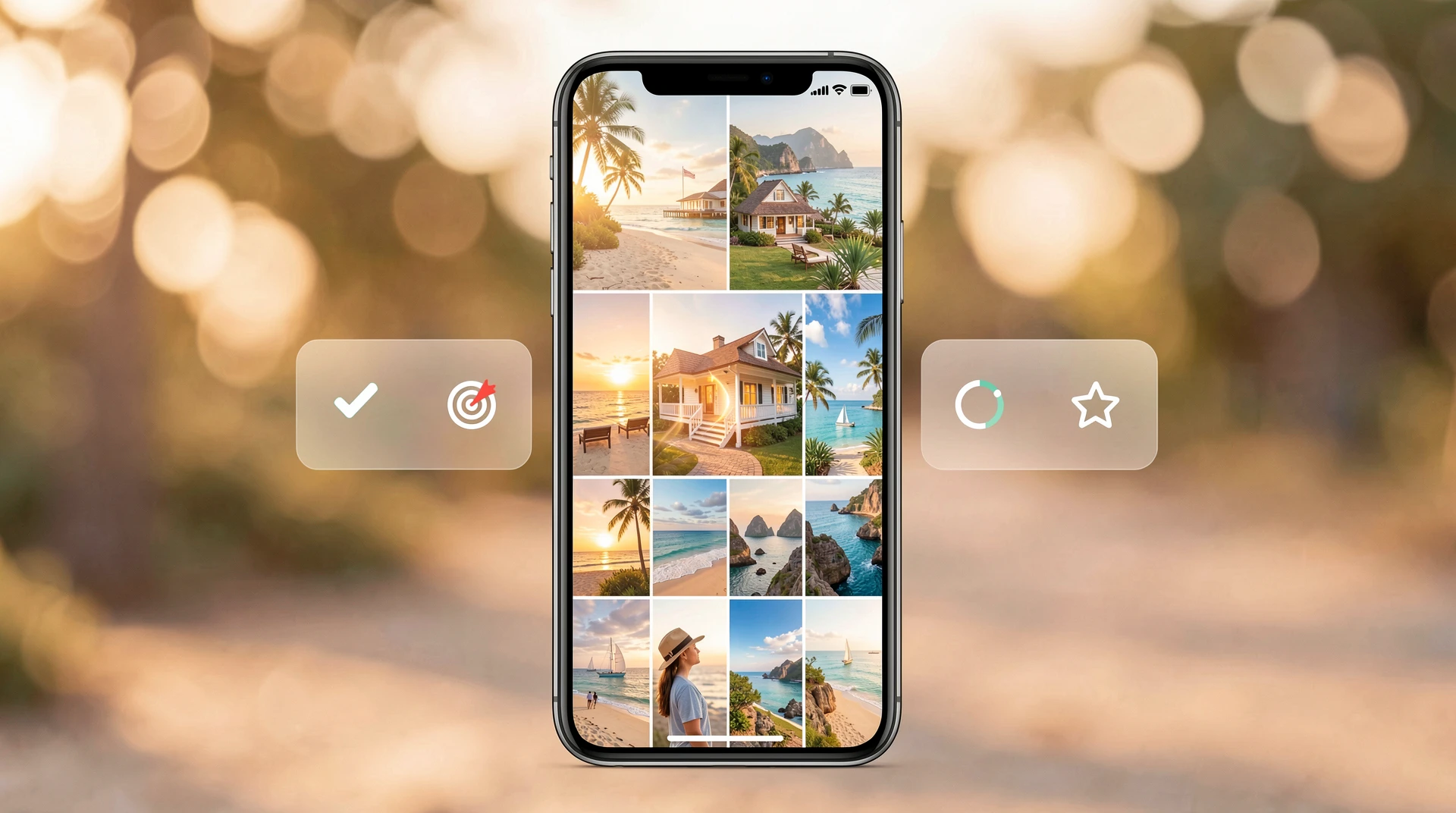
Here's the thing nobody selling a gorgeous collage template wants to say out loud: a finished picture doesn't ask anything else of you. You built it. You felt something. And then — nothing. Most people open the app once, maybe twice, and by month three it's just wallpaper. Literally.
What the Science Actually Says About Vision Boards
Your brain takes in roughly 11 million bits of sensory information every second. Your conscious mind can process about 50 of them. The Reticular Activating System — a bundle of neurons at the base of your brainstem — decides which 50 make the cut. Show it the same goal-relevant images every day, and it starts flagging the people, opportunities, and resources connected to that goal in your actual environment. Researchers call this selective attention, and it's the same mechanism behind the famous "invisible gorilla" experiment — Simons and Chabris, 1999 — where people staring at a basketball game missed a gorilla walking through the middle of the screen because their attention was pointed elsewhere.
There's a physical version of this too. A 2004 Cleveland Clinic Foundation study found that people who only mentally rehearsed an exercise — no actual movement — increased muscle strength by 13.5%. Alvaro Pascual-Leone's 1995 Harvard study found something similar with piano: mental practice alone produced cortical changes close to what physical practice produced. Add in the picture superiority effect — Paivio, 1971, found people retain 65% of visual information after three days versus 10% of written text — and the case for a visual daily prompt holds up.
But here's the catch, and it's the part most vision board marketing conveniently skips: imagining the outcome and imagining the process are not the same thing, and only one of them works. Gabriele Oettingen's research at NYU found that people who vividly pictured a desired outcome — the dream job, the finished marathon, the healed relationship — showed less energy and effort afterward than people who didn't picture it at all. Your brain got a preview of the reward and relaxed. Pham and Taylor's 1999 UCLA study backs this up from another angle: students who visualized the work of studying outscored the ones who only visualized the grade. And that 2011 Kappes and Oettingen study from the opening? Same finding, sharper — positive fantasy without a plan for the obstacles actively reduces the odds you follow through.
"Process visualization — imagining yourself doing the work, handling obstacles, executing the steps — improves performance. Outcome fantasy — imagining the result as already achieved — can undermine it."
The Three Camps Every Vision Board Falls Into
Storyflow's founder, a documentary filmmaker named Justkay, tested 12 apps across three real use cases over three weeks and landed on a framework that explains almost everything about why these tools succeed or fail: the Revisit Test. The question is simple. What happens the second time you open it?
"A vision board you build once and never open again is a screensaver. A vision board you revisit weekly and evolve quarterly is a planning tool." — Justkay, Storyflow
That single question splits the market into three camps. The Static Wall — Pinterest, Canva, Milanote — gives you a beautiful, finished board and nothing else; open it twice and there's no reason to be there. The Ritual App — Hay House, VisuApp, My Manifestation — solves the revisit problem with a daily affirmation or visualization practice bolted onto the board. And the Vision-Plus-Action camp — Storyflow, Notion, Padlet — puts your goals, timelines, and next steps on the same surface as the imagery, so there's always a reason to come back.
Guess which camp wins.
In Storyflow's own rankings, goal integration counted for 25% of the score — more than any other single factor — and the Vision-Plus-Action apps outscored every Static Wall and Ritual App tested. Most boards die, in Justkay's words, "at the second open." The ones that survive hold a plan, not just a picture.
Digital Vision Board vs. Physical Vision Board: Why the Medium Is Only Half the Story
Cutting magazine images and pinning them to a corkboard is a real practice — tactile, a little meditative, and it puts something in your physical space you can't help but see. But a digital vision board wins on one variable that swamps everything else: frequency. The average person unlocks their phone 80 to 100 times a day. Set your board as your lock screen, and it gets more visual impressions in a single week than a poster gets in a month facing your closet wall.
That's not a knock on physical boards — it's a reminder that the medium isn't the lever. Exposure is. A gorgeous digital vision board buried three folders deep in your photo app is just as dead as a poster facing the wall. The apps that actually work make the board impossible to avoid: lock screen widgets, daily notifications, a slideshow that opens on its own. Passive placement doesn't train your RAS. Repetition does.
The Best Vision Board App in 2026: Our Top Picks
So which one do you actually download? Judged purely on features, a dozen apps look similar — collage tools, template libraries, a free tier. The thing that separates a useful app from a pretty one is the same criterion from the Revisit Test above: does it connect the picture to a measurable next action, or does it stop at the collage?
| App | Camp / Type | Rating | Price | What Makes It Different |
|---|---|---|---|---|
| Storyflow | Vision-Plus-Action | 8.9/10 | Free / $7.99/mo | Goal cards, timelines, and imagery share one surface — highest score for goal integration in its own 12-app test |
| Vision Board ++ | Ritual App | 4.9★ (9,057 ratings) | $19/yr | Only app combining streak tracking, music/voice slideshow, and home-screen widgets |
| ManifestedMe | Structured Framework | — | Free tier / Premium | Links each board image to a milestone-tracked goal across 8 life areas |
| Dreamfora | Goal Cards | — | Free / $5.99/mo | Not a traditional board — goal cards tied directly to habit tracking |
| LoA | Ritual App | — | Free | 3D immersive board plus affirmation overlays and streak-based daily reminders |
If all you want is a goal tracking app with a picture stapled to it, Dreamfora does that honestly and for free. If you want the daily-ritual pull — streaks, audio, a reason to open the app every morning — Vision Board ++ is the highest-rated purpose-built option, at 4.9 stars across 9,057 reviews. But the tools that keep scoring highest on goal integration, Storyflow among them, are the ones that stopped treating the board as the finish line and started treating it as page one of a plan.
From Vision to Execution: Where the Best Boards Hand Off
Every source in this comparison agrees on the same funnel, even when they don't use the same words for it: vision flows to goal, goal flows to plan, plan flows to action. Boards — physical or digital, static or ritual — only ever address the first link. That's not a flaw, exactly. It's a boundary. The problem is an entire industry pretending the first link is the whole chain.
This is exactly the gap IdealWeek's Dream Factory and OKR Engine are built to close. The Dream Factory is where the picture lives — the same impulse that makes you drag a beach house photo onto a collage. But instead of stopping there, that idea flows directly into an Objective with weighted, measurable Key Results, each carrying its own deadline. The board doesn't get retired to a folder three months from now. It gets a next action, this week, on your calendar.
"The vision board apps that actually work are the ones that bridge the gap between the image and the effort." — Mindful Suite analysis
Finding the Right Fit for Your Goals
So — no single app crowned "best" fixes a board that never gets action attached to it. If you want the highest-rated dedicated experience, Vision Board ++ has the ratings and the retention features to back it up. If your goals already live in a workspace, Storyflow or Notion will feel more natural than a separate app. But whichever vision board app you pick, the test that matters isn't how it looks on day one. It's what it hands you on day seven.
Open whichever app you already downloaded. Look at the board you built. Pick one image on it and write down the single next action that image requires — today, not "someday." That's the difference between a screensaver and a plan. 🎯
Related Articles
View all →
Best AI Goal Setting Apps in 2026: The Honest, Data-Backed Ranking
"Launch a side business by year-end."
Best Goal Tracking Apps in 2026: Find the One That Actually Works
You've downloaded a goal tracking app before. Probably more than one. You set up your goals, felt motivated for about 72 hours, and then the…

How to Build a Personal Operating System from Scratch in 2026
Most people run their life on three things: adrenaline, memory, and willpower. Three of the most fragile systems ever invented.